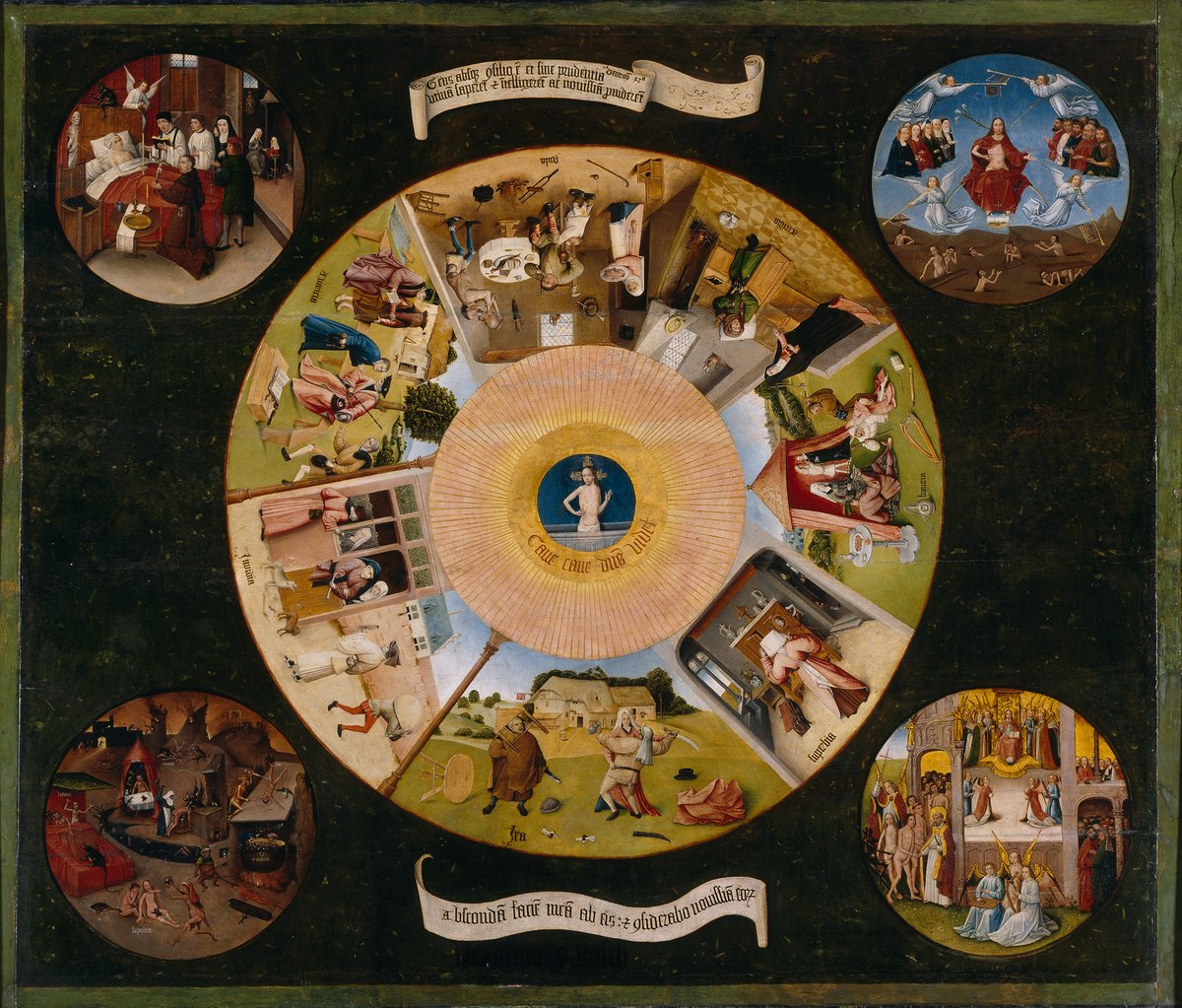
Table of the Seven Deadly Sins by Hieronymus Bosch
$56.29
Type
Size
Frame Color
Quantity
1
Table of the Seven Deadly Sins by Hieronymus Bosch: what it depicts
Table of the Seven Deadly Sins by Hieronymus Bosch (c. 1505–10)
Beware, the Lord is watching
The panel is laid out like an eye. At its centre, in a small blue pupil, Christ stands in his tomb as the Man of Sorrows, showing the wound in his side. Gold rays run out from him to a ring of seven scenes, and beneath him is the Latin warning Cave cave d[omi]n[u]s videt: "Beware, beware, the Lord is watching." The Prado describes the great circle as resembling a huge eye or a concave mirror.
Seven sins in ordinary life
Bosch does not personify the sins. He shows people committing them, in rooms, yards and streets, with each scene labelled in Latin. Wrath (ira), at the bottom, directly below Christ, is a drunken brawl outside a tavern, with a woman trying to hold one of the fighters back. Moving anticlockwise, Pride is a woman in a fine room preening in a mirror that a devil holds up for her. Lust is two courtly couples dallying in a tent, entertained by a jester. Sloth is a man dozing by the fire while a figure in a nun's habit comes to remind him of his prayers. In Gluttony a fat man eats greedily and a drunkard swigs from a bottle, ignoring a child who begs for food. In Greed a judge listens to one party in a lawsuit and takes a bribe from the other behind his back. In Envy a couple covet the falcon a rich man is showing off, and two dogs quarrel over a single bone.
The Prado notes that Bosch conveys this moral teaching through everyday situations among people of different classes, and that some of the scenes, Gluttony above all, make him a pioneer of genre painting. Each scene has its ground towards the outer edge of the circle, so those at the top of the photograph appear upside down.
The Four Last Things
In the corners are four smaller roundels. At the upper left is Death: a man in bed receives the last rites while an angel and a demon wait, and Death himself stands in the doorway. At the upper right is the Last Judgement, with Christ in glory and the dead rising from their graves. At the lower right is Glory, where Saint Peter welcomes the blessed into Heaven, shown as a Gothic building against gold. At the lower left is Hell, where sinners receive punishments that fit their sins.
Two scrolls carry verses from Deuteronomy. The upper one, between Death and Judgement, reads in translation: "For they are a nation void of counsel, neither is there any understanding in them. O that they were wise, that they understood this, that they would consider their latter end!" The lower one, between Hell and Glory, reads: "I will hide my face from them, I will see what their end shall be."
Who painted it
The panel is signed by Bosch, and the Prado finds no evidence that the signature is false. Its authorship has nonetheless been questioned since 1898. Most doubts start from a passage in Felipe de Guevara's Comentario de la pintura, written around 1560 and first published in 1788, which seems to connect the work with an unnamed gifted follower. In 2015 the Bosch Research and Conservation Project assigned it to such a follower, and Wikidata and Wikimedia Commons catalogue it as "Bosch or follower".
The Prado keeps it as Bosch. In the entry for its 2016 centenary exhibition, Pilar Silva Maroto reads Guevara's passage as ambiguous, points out features of the underdrawing shared with late works such as The Haywain, and argues that so original a design is unlikely to be a follower's. Because the panel is poplar rather than oak, it cannot be dated by tree rings; the style and the costumes, especially the hats, point to about 1505–10, late in Bosch's career.
Philip II and the Escorial
Nothing is known of the first owner or of what the panel was for. Philip II of Spain owned it before 1560, sent it to the Monastery of San Lorenzo de El Escorial in 1574, and kept it in his private apartment there until his death. It stayed at the Escorial until 1936, when it was lent to the Prado, and it remains there on permanent loan from Patrimonio Nacional. It is oil on poplar, 119.5 by 139.5 centimetres.
About this print
Made from a photograph of the whole panel, including the dark ground around the circles, so the four roundels and the two scrolls keep their places.
Sources: Museo del Prado, Madrid, P002822 · Wikimedia Commons · Wikidata Q2304870 · Wikipedia, "The Seven Deadly Sins and the Four Last Things", "Hieronymus Bosch"
Who Made It
Created by Hieronymus Bosch. Painted in 1505. Oil on wood.
More like this: Last Judgment
All Available Options
Below is a list of all available sizes and product types.
| Type | Size | Color | Price | Availability |
|---|---|---|---|---|
| Canvas | 10" x 8" (Horizontal) | - | $31.52 | In Stock |
| Canvas | 14″ x 11″ (Horizontal) | - | $37.49 | In Stock |
| Framed | 10″ x 8″ (Horizontal) | Black | $56.29 | In Stock |
| Framed | 10″ x 8″ (Horizontal) | Espresso | $56.29 | In Stock |
| Framed | 10″ x 8″ (Horizontal) | White | $56.29 | In Stock |
Image: source, Public domain.
Shipping & Returns
All items are custom-made just for you! We partner with trusted print providers for fulfillment. Orders ship in 3-5 business days, with delivery in 5-10 business days.
Reviews
No reviews of Table of the Seven Deadly Sins by Hieronymus Bosch yet. We invite every customer to write one after their print arrives, and we publish them whether or not they are flattering.