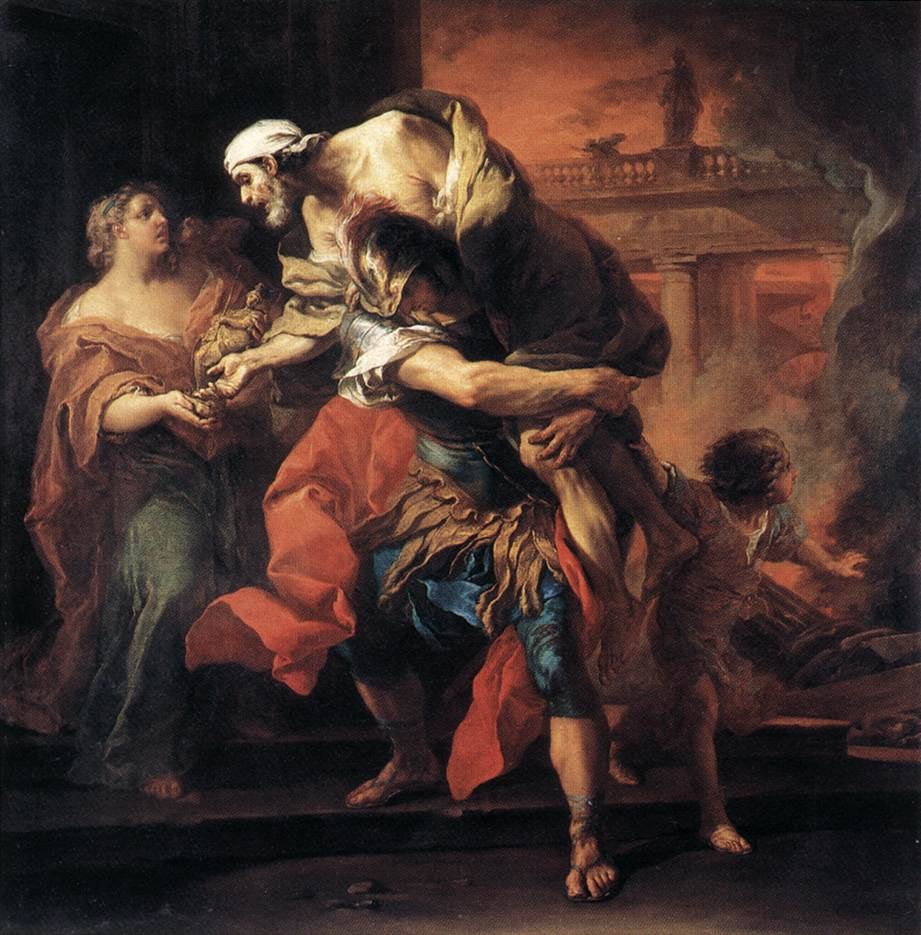
Aeneas Carrying Anchises by Charles-André van Loo
$51.02
Type
Size
Frame Color
Quantity
1
Aeneas Carrying Anchises by Charles-André van Loo: what it depicts
Charles-André van Loo: The Artist and His Significance
Charles-André van Loo (1705–1765), a prominent French painter of the eighteenth century, belonged to the illustrious van Loo family, known for its deep artistic heritage. Born in Nice, Charles-André, the son of Louis-Abraham van Loo, was trained by his elder brother, Jean-Baptiste van Loo, and in Rome by Benedetto Luti. His comprehensive education included studies in Rome, where he absorbed influences from both High Renaissance and Baroque masters. Recognized for his technical brilliance and versatility, van Loo became a favored painter in the court of Louis XV, earning prestigious titles including First Painter to the King and director of the French Academy.
Van Loo’s work displays a synthesis of precise academic drawing, vibrant color, and an affinity for grand themes drawn from history, mythology, and religion. His role in the Rococo period was distinguished by his more restrained style, which favored clarity and emotional gravity over decorative excess, setting him apart from many contemporaries.
Historical Context of "Aeneas Carrying Anchises"
"Aeneas Carrying Anchises" was painted in 1729, when the Rococo was at its height, though the art and literature of antiquity remained a constant source of subjects. The eighteenth century saw a renewed interest in epic narratives as models of virtue and heroism, and the Aeneid—Virgil’s celebrated Roman epic—was a source of endless fascination.
This scene depicts the flight of Aeneas from the burning city of Troy, carrying his elderly father, Anchises, on his shoulders, while his young son Ascanius runs beside them. As classical themes became central to Enlightenment ideas of civic duty, personal sacrifice, and nobility, the episode resonated deeply, symbolizing the passage of culture and legacy across generations.
Religious and Cultural Significance
Though rooted in Roman myth, the image of Aeneas carrying Anchises also held powerful Christian connotations, particularly the concept of filial piety, Christian charity, and the endurance of faith and virtue amid adversity. For Enlightenment and post-Reformation audiences, such themes served as moral exemplars, reinforcing the connection between classical virtue and contemporary ethical ideals.
The Aeneas narrative—central to Rome’s legendary foundation—was often appropriated by monarchs and nations seeking to underline their own origins and destinies. In France, the Bourbons used allusions to classical heroes like Aeneas to legitimize their rule and frame themselves as inheritors of both Roman and Christian traditions.
Symbolism and Iconography
The composition is rich in classical symbols. Aeneas embodies pietas (duty to family, gods, and homeland), depicted as a heroic figure whose strength and resolve contrast with his frail, ailing father. Anchises, often shown clutching a small household god (penates), represents both the weight of tradition and the spiritual inheritance that must be preserved and transported to a promising future.
Ascanius, the youngest figure, is the hope of the next generation, signifying continuity and renewal. The burning city of Troy in the background marks the destruction from which the new Rome will rise. The act of carrying speaks to the burden of leadership, the passage of wisdom, and the necessity of survival through family and faith.
Artistic Techniques
Van Loo’s technical mastery is evident in his careful composition and use of light. The figures are arranged in a pyramidal structure, a technique drawn from Renaissance traditions to convey stability and clarity. The interplay between warm and cool tones animates the drama of night and fire, lending emotional immediacy and naturalism to the mythic scene.
His brushwork is precise but not excessively detailed, maintaining a balance between idealized anatomy and believable physicality. The rendering of flesh, drapery, and flame displays van Loo’s study of both classical sculpture and the works of Caravaggio and Poussin. Expressive gestures and facial expressions heighten the emotional resonance, inviting viewers to empathize with the plight of the protagonists.
Attention to detail is reflected in Anchises’ lined face and stooped posture, Aeneas’s muscular tension, and Ascanius’s tentative stride. The careful treatment of the burning cityscape suggests ruin without distracting from the emotional core of the tableau.
Cultural Impact
The theme of Aeneas carrying Anchises has persisted as a symbol of endurance, filial duty, and civilizational renewal. Van Loo’s interpretation, painted decades before the Neoclassical revival, shows the enduring appeal of such classical subjects within Rococo painting. The image echoed through literature, visual art, and political rhetoric.
During the French Enlightenment, such works were paralleled by philosophical meditations on history, migration, and the duty to preserve ideals through upheaval. The painting’s imagery would even be invoked in times of national crisis and revolution as a touchstone for sacrifice, identity, and hope.
By focusing on a narrative of loss and rebuilding, van Loo’s "Aeneas Carrying Anchises" anticipated the values and visual language that would soon dominate the neoclassical era. Its emotional force and visual clarity continue to speak to questions of heritage, memory, and the obligations shared between generations.
Sources
- Musée du Louvre. “Énée portant Anchise” (INV. 6278).
- Honour, Hugh. Neo-Classicism. Penguin Books, 1968.
- Virgil. The Aeneid. Various translations.
- Encyclopedia Britannica. “Charles-André van Loo.” www.britannica.com
Who Made It
Created by Charles-André van Loo. Painted in 1729.
All Available Options
Below is a list of all available sizes and product types.
| Type | Size | Color | Price | Availability |
|---|---|---|---|---|
| Canvas | 6" x 6" | - | $33.26 | In Stock |
| Canvas | 10″ x 10″ | - | $41.66 | In Stock |
| Canvas | 12″ x 12″ | - | $41.47 | In Stock |
| Canvas | 14" x 14" | - | $44.47 | In Stock |
| Canvas | 16" x 16" | - | $50.01 | In Stock |
| Canvas | 20″ x 20″ | - | $92.18 | In Stock |
| Canvas | 24″ x 24″ | - | $105.21 | In Stock |
| Framed | 6" x 6" | Black | $51.02 | In Stock |
| Framed | 6" x 6" | Espresso | $51.02 | In Stock |
| Framed | 6" x 6" | White | $51.02 | In Stock |
| Framed | 8" x 8" | Black | $52.87 | In Stock |
| Framed | 8" x 8" | Espresso | $52.87 | In Stock |
| Framed | 8" x 8" | White | $52.87 | In Stock |
| Framed | 10″ x 10″ | Black | $64.92 | In Stock |
| Framed | 10″ x 10″ | Espresso | $64.92 | In Stock |
| Framed | 10″ x 10″ | White | $64.92 | In Stock |
| Framed | 12″ x 12″ | Black | $79.40 | In Stock |
| Framed | 12″ x 12″ | Espresso | $79.40 | In Stock |
| Framed | 12″ x 12″ | White | $79.40 | In Stock |
| Framed | 14" x 14" | Black | $88.06 | In Stock |
| Framed | 14" x 14" | Espresso | $88.06 | In Stock |
| Framed | 14" x 14" | White | $88.06 | In Stock |
| Framed | 16″ x 16″ | Black | $101.29 | In Stock |
| Framed | 16″ x 16″ | Espresso | $101.29 | In Stock |
| Framed | 16″ x 16″ | White | $101.29 | In Stock |
| Framed | 20″ x 20″ | Black | $129.61 | In Stock |
| Framed | 20″ x 20″ | Espresso | $129.61 | In Stock |
| Framed | 20″ x 20″ | White | $129.61 | In Stock |
| Framed | 24″ x 24″ | Black | $163.96 | In Stock |
| Framed | 24″ x 24″ | Espresso | $163.96 | In Stock |
| Framed | 24″ x 24″ | White | $163.96 | In Stock |
Shipping & Returns
All items are custom-made just for you! We partner with trusted print providers for fulfillment. Orders ship in 3-5 business days, with delivery in 5-10 business days.
Reviews
No reviews of Aeneas Carrying Anchises by Charles-André van Loo yet — here is what customers say about the prints they bought from us. We invite every customer to write one after their print arrives, and we publish them whether or not they are flattering.
From our customers
- Fantastic print, makes me happy
Arrived great, definitely feels good in the hand & quality frame
Thomas · The Incredulity of Saint Thomas