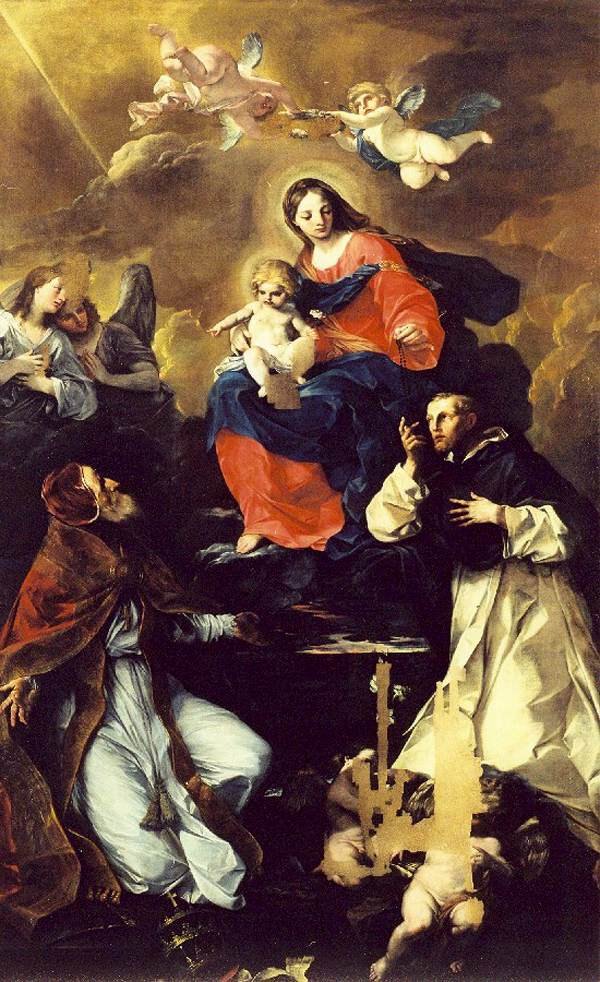
Virgin and Child with Angels and Saints by Felice Torelli: what it depicts
Virgin and Child with Angels and Saints by Felice Torelli: A Study
The Artist: Felice Torelli’s Background and Significance
Felice Torelli (1667–1748) was an influential Italian painter of the late Baroque period. Born in Verona to a family of artists, Torelli studied painting under Santo Prunati before moving to Bologna with his brother Giuseppe, a violinist and composer, where he frequented the studio of Giovanni Gioseffo dal Sole. His artistic journey was marked by significant collaborations and a leadership role in the Bolognese art community, where he helped found the Accademia Clementina. Torelli’s works are characterized by dark, sombre color, dramatic contrasts, and an affinity for religious themes, reflecting the late Baroque era’s dynamic spirituality and theatricality.
Torelli’s standing in Italian art is attributed to his refined technique, theological sensitivity, and capacity to merge Bolognese academic rigor with Baroque exuberance. His paintings—often large-scale altarpieces for churches—bridge the classicism of the seventeenth century and the burgeoning Rococo style of the early eighteenth century.
Historical Context of the Artwork
Painted circa 1700, Virgin and Child with Angels and Saints surfaced during a period of intense religious transformation and artistic vigor. The Catholic Church, still engaged in the spiritual renewal sparked by the Counter-Reformation, continued to commission works that reinforced core Christian virtues and encouraged devotional practice through emotive storytelling. The Baroque style, with its grandeur, movement, and emotional involvement, was ideally suited to religious subjects demanding both doctrinal clarity and affective appeal.
Bologna, where Torelli worked, was a thriving religious and cultural center with flourishing artistic activity promoted by aristocratic and ecclesiastical patrons. The city’s academic traditions and openness to innovation enabled artists to experiment within orthodox themes, resulting in works like Torelli’s that fuse tradition with a refreshed visual vitality.
Religious and Cultural Significance
The subject of the Virgin and Child surrounded by angels and saints resonated deeply in Catholic tradition. This theme not only emphasizes the centrality of Mary and Christ in salvation history but also presents the communion of saints—a core Catholic doctrine—visualized through their collective adoration and intercession.
In Torelli’s time, such paintings would have reinforced Marian devotion, which was promoted as a bulwark of faith amid religious uncertainties. The painting likely adorned an altar or chapel, serving as a focal point for prayer and contemplation. For congregants, the depiction of angels and saints modeled ideals of piety, humility, and devotion to the Virgin and Child.
Symbolism and Iconography
Virgin and Child with Angels and Saints is laden with symbolic content that seeks to express theological ideas in accessible visual language:
- Virgin Mary: Often depicted enthroned or elevated, Mary embodies maternal compassion and divine grace. Her blue mantle symbolizes purity and her role as Queen of Heaven, while the Christ Child in her arms serves as a tangible reminder of the Incarnation.
- The Christ Child: Frequently presented blessing or reaching out to the saints, symbolizing Christ’s accessibility and redemptive mission.
- Angels: Typically shown in adoration or celebration, angels reinforce the heavenly significance of the scene and act as mediators between the divine and the earthly.
- Saints: Their inclusion demonstrates the intercessory power of the Church triumphant. Individual saints are recognized by their attributes—here a pope with his tiara at his feet and a friar in the black-and-white Dominican habit—serving both devotional and didactic functions.
Torelli’s arrangement of these figures constructs a visual hierarchy, leading the viewer’s gaze from the adoring saints and angels upward to the sacred focal point of Mary and Jesus. The dramatic organization suggests heavenly convergence, drawing attention to the central mysteries of Christian faith.
Artistic Techniques
Torelli’s mastery of the oil-on-canvas medium is evident in his adept use of color, light, and movement—all hallmarks of Baroque painting:
- Color: Torelli employs rich, saturated hues to differentiate sacred protagonists and evoke emotional warmth. The interplay between Mary’s luminous blue robes and the warmer tones of attendant figures accentuates her prominence.
- Light: Caravaggesque chiaroscuro—dramatic contrasts between light and shadow—heightens the spiritual fervor of the composition. Divine light often appears to emanate from the Christ Child, flooding the faces of those in adoration.
- Composition: The arrangement is dynamic yet harmonious, with rhythmic gestures and flowing drapery guiding the viewer’s eye. Figures are often interlinked by glances and gestures, reinforcing spiritual unity.
- Surface Treatment: Torelli’s sensitive brushwork captures both the softness of flesh and the sumptuous textures of fabric, balancing realism with idealization.
Torelli’s technical prowess allows for an immersive viewing experience; the sense of immediacy, physical presence, and emotive force is intended to draw the faithful into deeper meditative engagement.
Cultural Impact
Virgin and Child with Angels and Saints attests to Torelli’s pivotal role in advancing the stylistic currents of his era. His interpretation of familiar religious themes contributed to the visual culture of Catholic devotion, informing both public worship and private prayer. Torelli’s influence extended through his work at the Accademia Clementina, where he trained the next generation of Bolognese artists, helping to shape Italian painting’s trajectory well into the eighteenth century.
The enduring appeal of Torelli’s work, as seen in the continued appreciation of Virgin and Child with Angels and Saints, is rooted in its fusion of technical excellence, theological resonance, and emotive immediacy. This canvas encapsulates the aspirations of late Baroque religious art—to inspire, instruct, and transport believers through compelling visual storytelling.
Sources
- The Oxford Dictionary of Art and Artists, "Felice Torelli"
- Grove Art Online, "Torelli, Felice" entry
- Web Gallery of Art, "Felice Torelli"
Who Made It
Created by Felice Torelli. Painted in 1700. Oil on canvas.
More like this: Madonna and Child, Virgin Mary, Angels, Saints, Baroque
All Available Options
Below is a list of all available sizes and product types.
| Type | Size | Color | Price | Availability |
|---|---|---|---|---|
| Canvas | 12″ x 18″ (Vertical) | - | $44.13 | In Stock |
| Canvas | 16″ x 24″ (Vertical) | - | $71.62 | In Stock |
Image: source, CC BY-SA 4.0.
Shipping & Returns
All items are custom-made just for you! We partner with trusted print providers for fulfillment. Orders ship in 3-5 business days, with delivery in 5-10 business days.
Reviews
No reviews of Virgin and Child with Angels and Saints by Felice Torelli yet — here is what customers say about the prints they bought from us. We invite every customer to write one after their print arrives, and we publish them whether or not they are flattering.
From our customers
- Fantastic print, makes me happy
Arrived great, definitely feels good in the hand & quality frame
Thomas · The Incredulity of Saint Thomas