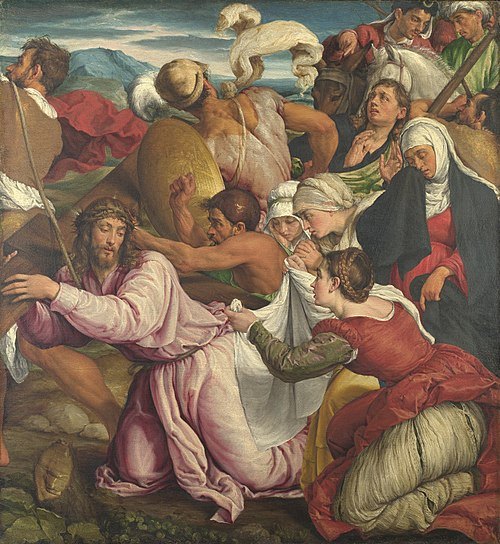
The Way to Calvary by Jacopo Bassano: what it depicts
Jacopo Bassano and the Venetian Renaissance
Jacopo Bassano (c. 1510–1592), born Jacopo dal Ponte in the town of Bassano del Grappa near Venice, stands as a distinctive figure in Renaissance painting. Known for blending Venetian colorism with earthy, narrative-driven scenes, Bassano established a legacy that bridged everyday realism and religious narrative. Working closely with his family workshop, his influence extended well beyond his hometown, shaping the Venetian art scene and leaving enduring marks on later Baroque painters.
Historical Context of "The Way to Calvary"
Painted around 1540, The Way to Calvary emerges amidst the flourishing culture of the Venetian Renaissance, a period marked by a vibrant exchange of ideas and styles. The early 16th century was an era of both religious faith and growing humanist interest in the ordinary and the real. The Catholic Church wielded great power, commissioning artworks to instruct and inspire the faithful, while social and political changes ignited an appetite for more personal, emotive artistic expression. Bassano, situated on the periphery of Venice’s cultural hub, merged the drama coming from Venice with local traditions and rural themes, infusing biblical stories with immediacy and humanity.
Religious and Cultural Significance
The Way to Calvary depicts Christ’s arduous journey carrying the cross to Golgotha—an event central to Christian belief, encapsulating themes of sacrifice, redemption, and human suffering. Such scenes were meant not only to illustrate sacred history but to foster empathy among viewers, encouraging meditative reflection on Christ’s passion. For Renaissance audiences, the painting served as both spiritual lesson and visual meditation, reinforcing doctrinal truths and the emotional realities of faith.
Symbolism and Iconography
Bassano’s interpretation of the Via Crucis is laden with symbolic detail. At the left, Jesus, fallen to his knees beneath the cross yet spiritually resolute, turns towards Veronica, who kneels to offer her veil—an invitation to contemplation and participation in the event. The onlookers and soldiers, rendered with lifelike individuality, represent a spectrum of human response: cruelty, indifference, sorrow, and compassion. Figures such as Mary, often shown in anguish, and Simon of Cyrene, compelled to help bear the cross, underscore themes of shared suffering and reluctant assistance.
Notable is Bassano’s setting of the scene within a recognizable landscape, possibly reflecting the Veneto countryside. He integrates ordinary rural people and animals into the narrative, grounding the biblical drama in the everyday experience of his audience. This localization transforms the event from distant history to an immediate, lived encounter.
Artistic Techniques
Bassano’s The Way to Calvary exemplifies his mastery of oil on canvas, allowing for luminous color, fine detail, and subtle modeling of form.
- Color: Drawing from Venetian forebears like Titian, Bassano employs a rich and varied palette. His use of warm earth tones and vivid contrasts heightens the emotional intensity and draws focus to key figures.
- Light: The interplay of light and shadow animates the composition, creating depth and a sense of palpable atmosphere. Bassano’s handling of light is less idealized than some contemporaries, choosing instead to highlight the gritty realism and pathos of the scene.
- Composition: He constructs the painting with a dynamic, crowd-filled arrangement, leading the eye through chaos toward Christ at the left. The diagonal thrust of the cross and the procession amplifies the drama, compelling viewers to follow the narrative through visual movement.
- Naturalism: Bassano’s attention to facial expression, posture, and gesture breathes life into each figure. His inclusion of local dress and landscape details reflects the late Renaissance interest in merging the sacred with the familiar.
Cultural Impact
The Way to Calvary stands as a testament to Bassano’s ability to humanize biblical narrative. By fusing Venetian color and compositional vitality with earthy naturalism, Bassano brought a new emotional immediacy to religious art. His works influenced generations of artists both within and beyond his own family workshop, shaping the evolution of narrative painting in northern Italy.
The cultural resonance of Bassano’s approach lay in his capacity to make religious stories feel accessible and relatable, underscoring the enduring relevance of faith amidst the realities of daily life. His localizing of the sacred paved the way for later Baroque artists such as Caravaggio, who deepened the sense of drama and realism in religious scenes.
Today, The Way to Calvary not only provides insight into Renaissance spirituality and social life but also demonstrates the transformative power of art to connect universal themes of suffering, empathy, and hope across the centuries.
Sources
- Rosand, David. Painting in Sixteenth-Century Venice: Titian, Veronese, Tintoretto. Cambridge University Press, 2012.
- Humfrey, Peter. Painting in Renaissance Venice. Yale University Press, 1995.
- National Gallery, London. “Jacopo Bassano and Family.” https://www.nationalgallery.org.uk/artists/jacopo-bassano
- Web Gallery of Art. “Jacopo Bassano: The Road to Calvary.” https://www.wga.hu/
- Grove Art Online. "Jacopo Bassano." Oxford Art Online, https://www.oxfordartonline.com
Who Made It
Created by Jacopo Bassano. Painted in 1540. oil on canvas.
More like this: Passion of Christ, Crucifixion, Jesus Christ, Renaissance
All Available Options
Below is a list of all available sizes and product types.
| Type | Size | Color | Price | Availability |
|---|---|---|---|---|
| Canvas | 6" x 6" | - | $33.26 | In Stock |
| Canvas | 12″ x 12″ | - | $41.47 | In Stock |
| Canvas | 16" x 16" | - | $50.01 | In Stock |
| Framed | 6" x 6" | Black | $51.02 | In Stock |
| Framed | 6" x 6" | Espresso | $51.02 | In Stock |
| Framed | 6" x 6" | White | $51.02 | In Stock |
| Framed | 10″ x 10″ | Black | $64.92 | In Stock |
| Framed | 10″ x 10″ | Espresso | $64.92 | In Stock |
| Framed | 10″ x 10″ | White | $64.92 | In Stock |
| Framed | 14" x 14" | Black | $88.06 | In Stock |
| Framed | 14" x 14" | Espresso | $88.06 | In Stock |
| Framed | 14" x 14" | White | $88.06 | In Stock |
Image: source, CC BY-SA 4.0.
Shipping & Returns
All items are custom-made just for you! We partner with trusted print providers for fulfillment. Orders ship in 3-5 business days, with delivery in 5-10 business days.
Reviews
No reviews of The Way to Calvary by Jacopo Bassano yet — here is what customers say about the prints they bought from us. We invite every customer to write one after their print arrives, and we publish them whether or not they are flattering.
From our customers
- Fantastic print, makes me happy
Arrived great, definitely feels good in the hand & quality frame
Thomas · The Incredulity of Saint Thomas