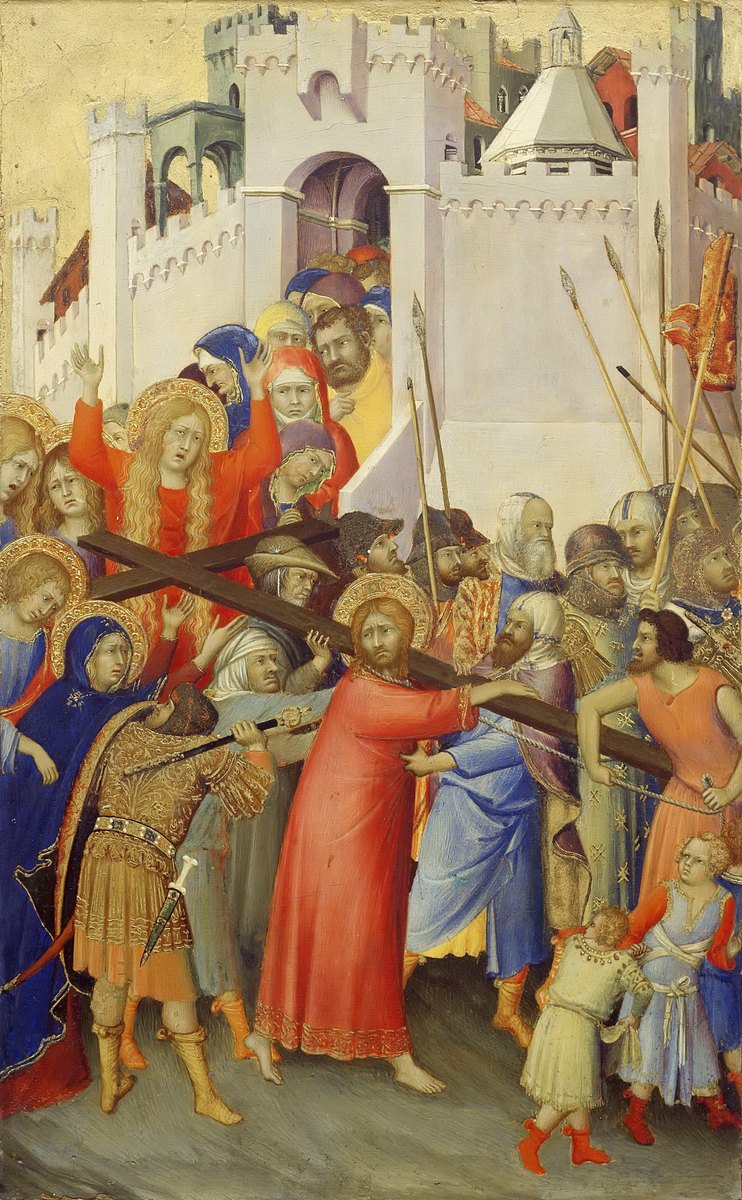
The Carrying of the Cross by Simone Martini
$97.92
Type
Size
Frame Color
Quantity
1
The Carrying of the Cross by Simone Martini: what it depicts
The Carrying of the Cross by Simone Martini
Simone Martini: Artist and Innovator
Simone Martini (c. 1284–1344), an illustrious figure in early Italian painting, was a pivotal member of the Sienese School. Martini’s contributions shaped the transition from the earlier Italo-Byzantine traditions to the lyrical Gothic style, influencing generations of painters across Italy and Europe. Renowned for his masterful use of line, vibrant color, and delicate emotional expression, Martini worked in Siena, Naples, Pisa, Orvieto, Assisi, and Avignon, the latter serving as the seat of the Papal court in the 14th century.
Simone Martini’s legacy is intertwined not just with his technical achievements, but also with his ability to humanize sacred subjects, giving them a poetic internal resonance. His work reflects Siena’s devotion to spirituality and its place as a center of artistic innovation. Through collaborations with other luminaries, such as his brother-in-law Lippo Memmi, Martini’s artistry helped codify the International Gothic style that spread across medieval Europe.
Historical Context
The Carrying of the Cross, by Simone Martini, was created around 1335. One of the panels of the Orsini Polyptych, a small altarpiece made for the private devotion of a cardinal of the Orsini family (its other panels are in Antwerp and Berlin), it depicts a scene from the Passion of Christ—a major theme in Christian art throughout the Middle Ages. The 14th century in Italy was a period marked by deep religiosity, intense urban rivalries, and emerging humanistic philosophies. Artistic commissions were often funded by wealthy patrons, religious orders, or civic bodies eager to display both their faith and local identity.
In Martini’s Siena, pride in civic and religious institutions was profound. As European cities vied for artistic leadership, artists from Siena and Florence shaped new developments in naturalistic representation, narrative complexity, and emotional depth.
Religious and Cultural Significance
The scene of Christ carrying the cross is a key episode in the Passion narrative, representing Christ’s suffering, humility, and redemptive sacrifice. For medieval viewers, devotional images like The Carrying of the Cross were not simply illustrations, but windows into spiritual contemplation. Processional and narrative Passion imagery encouraged empathy and pious reflection, deepening the viewer’s emotional engagement with the mysteries of faith.
In Martini’s time, representations of the Passion functioned as powerful theological tools, connecting personal devotion with communal expressions of spirituality. They also reflected the growing movement toward affective piety—an emotional, imaginative worship that invited believers to meditate on Christ’s humanity and pain.
Symbolism and Iconography
Martini’s The Carrying of the Cross exemplifies the sophisticated iconography typical of late medieval painting. At the center, Christ bears the heavy cross, flanked by hostile soldiers and jeering figures. His face is marked with sorrow and compassion, emphasizing his innocence and steadfastness. The angular, almost rhythmic arrangement of bodies intensifies the sense of struggle and chaos, while Christ’s gentle clarity stands in stark contrast to his tormentors’ aggression.
With delicate detailing, Martini often highlighted Christ’s haloed head, a symbol of divinity and sanctity. The gold ground, a convention of Sienese painting, creates a transcendental, timeless space, reinforcing the scene’s sacred drama. The inclusion of the Virgin Mary, Mary Magdalene with her arms flung up, and the Holy Women at the left, pushed back by a soldier, would have evoked specific emotions, guiding viewers to feel sympathy, grief, and ultimately hope.
The very act of carrying the cross also prefigures Christian ideals of endurance, humility, and redemptive suffering—key teachings for Martini’s contemporaries.
Artistic Techniques and Style
Simone Martini was acclaimed for his refined draughtsmanship and the elegance of his line. In The Carrying of the Cross, Martini’s mastery is visible in the fluid contours of the drapery and the expressive faces. The gold leaf background—a feature inherited from Byzantine art—was worked with intricate tooling that lent a shimmering, ethereal quality.
Martini’s palette is rich but subtly modulated, often relying on lapis lazuli for blue and vermilion for red, both precious materials that signified the importance of the subject. Flesh tones are delicately blended, with careful attention to the modeling of Christ’s suffering yet dignified body. The composition itself reveals Martini’s narrative skill: figures are tightly grouped, creating a sense of psychological and physical tension that draws the viewer inward.
Unlike the Florentine emphasis on three-dimensional form and perspective, Martini favored a decorative flatness and linear grace. Elements such as pointed arches, elongated proportions, and intricate ornamentation typify the International Gothic manner that Martini helped define.
Martini’s paintings were admired for their lyrical, almost courtly sensibility—a quality that appealed to ecclesiastic patrons and the new cosmopolitan elite of Avignon.
Cultural Impact and Legacy
The Carrying of the Cross and similar works by Simone Martini marked a watershed moment in European art, bridging medieval spirituality with the visual sophistication that would characterize the Renaissance. Martini’s innovations in composition, his sensitive portrayal of emotion, and his elegant style had a profound impact not only in Italy but also across France, Spain, and Northern Europe, as Sienese painters traveled and their works circulated.
Martini's attention to human feeling and narrative detail helped lay the groundwork for later painters such as Fra Angelico and the Northern Renaissance masters. His synthesis of devotional intensity and courtly beauty ensured that religious painting remained both spiritually resonant and visually captivating for centuries.
Moreover, Martini's works are a testament to the vibrancy of Siena’s artistic culture, demonstrating how distinct regional styles could coexist with and enrich broader artistic movements. Today, The Carrying of the Cross is celebrated as a masterpiece of early Italian painting, embodying both the solemnity and the sublime lyricism that are hallmarks of Simone Martini’s genius.
Sources
- Norman, Diana. Painting in Late Medieval and Renaissance Siena, 1260–1555. Yale University Press, 2003.
- Christiansen, Keith. “Simone Martini (c. 1284–1344).” The Metropolitan Museum of Art.
- Gardner, Julian. “Simone Martini and Lippo Memmi.” The Oxford Companion to Western Art, Oxford University Press, 2001.
- O’Neill, J.P. (ed). Siena: Renaissance City of Art. Thames & Hudson, 1999.
- Smart, Alastair. The Dawn of Italian Painting, 1250–1400. Cornell University Press, 1978.
Who Made It
Created by Simone Martini. Painted in 1335.
More like this: Passion of Christ, Crucifixion, Jesus Christ
All Available Options
Below is a list of all available sizes and product types.
| Type | Size | Color | Price | Availability |
|---|---|---|---|---|
| Canvas | 12″ x 18″ (Vertical) | - | $44.13 | In Stock |
| Canvas | 24" x 36" (Vertical) | - | $94.11 | In Stock |
| Framed | 12″ x 18″ (Vertical) | Black | $97.92 | In Stock |
| Framed | 12″ x 18″ (Vertical) | Espresso | $97.92 | In Stock |
| Framed | 12″ x 18″ (Vertical) | White | $97.92 | In Stock |
| Framed | 16″ x 24″ (Vertical) | Black | $121.38 | In Stock |
| Framed | 16″ x 24″ (Vertical) | Espresso | $121.38 | In Stock |
| Framed | 16″ x 24″ (Vertical) | White | $121.38 | In Stock |
| Framed | 20″ x 30″ (Vertical) | Black | $146.73 | In Stock |
| Framed | 20″ x 30″ (Vertical) | Espresso | $146.73 | In Stock |
| Framed | 20″ x 30″ (Vertical) | White | $146.73 | In Stock |
| Framed | 24″ x 36″ (Vertical) | Black | $191.17 | In Stock |
| Framed | 24″ x 36″ (Vertical) | Espresso | $191.17 | In Stock |
| Framed | 24″ x 36″ (Vertical) | White | $191.17 | In Stock |
Image: source, CC BY-SA 4.0.
Shipping & Returns
All items are custom-made just for you! We partner with trusted print providers for fulfillment. Orders ship in 3-5 business days, with delivery in 5-10 business days.
Reviews
No reviews of The Carrying of the Cross by Simone Martini yet — here is what customers say about the prints they bought from us. We invite every customer to write one after their print arrives, and we publish them whether or not they are flattering.
From our customers
- Fantastic print, makes me happy
Arrived great, definitely feels good in the hand & quality frame
Thomas · The Incredulity of Saint Thomas