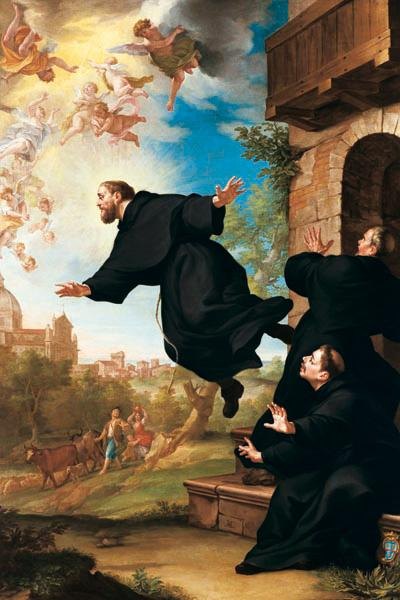
St. Joseph Cupertino by Ludovico Mazzanti: what it depicts
St. Joseph Cupertino by Ludovico Mazzanti
Medium: Oil on Canvas
Ludovico Mazzanti: The Artist’s Background and Significance
Ludovico Mazzanti (1686–1775) stands as a noteworthy figure in the late Baroque era of Italian painting. Born in Rome and raised in Orvieto, Mazzanti trained under Giovanni Battista Gaulli, called Baciccio, and worked extensively in both Rome and Naples. His oeuvre includes religious scenes and portraits, marked by intense drama and expressive movement, reflecting the emotive qualities valued in Italian Baroque art. Mazzanti’s ability to infuse traditional subjects with dynamic vitality earned him significant commissions from both ecclesiastical and noble patrons.
While he never gained the towering fame of older masters like Carlo Maratta or Luca Giordano, Mazzanti’s specialized focus on religious subject matter placed him at the heart of Counter-Reformation art. His paintings were designed to inspire piety and visually communicate the spiritual intensity of the Church.
Historical Context of "St. Joseph Cupertino"
The 18th century witnessed ongoing efforts within the Catholic Church to reinforce devotion and doctrinal purity following the Protestant Reformation. Art became one of the Church’s primary vehicles for religious expression and catechism. St. Joseph of Cupertino, canonized in 1767, became a favored subject due to his miraculous life as a Franciscan friar.
Mazzanti’s St. Joseph Cupertino captures this fervor for spiritual exemplars in the wake of renewed Catholic orthodoxy. The painting reflects not only the era’s artistic trends but also the Church’s strategic deployment of saints’ narratives to inspire wonder and faith among its followers.
Religious and Cultural Significance
St. Joseph of Cupertino (1603-1663) became renowned for his mystical abilities, most famously for undergoing ecstatic levitations during prayer and Mass. Despite humble beginnings and marked intellectual challenges, Joseph was celebrated as “the Flying Saint.” His life story echoed the values of humility, divine favor, and the supernatural intervention of God in the lives of the faithful.
Mazzanti’s rendering of St. Joseph would have resonated deeply within Catholic culture as an affirmation of miracles and the accessibility of divine grace, even to the least likely individuals. The image functioned as visual hagiography: not merely commemorating Joseph’s sanctity but urging viewers toward faith, wonder, and devotional awe.
Symbolism and Iconography
Mazzanti employs a visual language rich in Baroque symbolism to narrate the saint’s mystical experience. St. Joseph Cupertino is depicted in mid-flight, arms outstretched, oblivious to the earthly realm. These iconographic elements underline the miraculous nature of the saint: earthly laws, such as gravity, are suspended through divine intervention.
Here Mazzanti sets the miracle in the open air: the saint soars toward the domed Basilica of Loreto, seen in the distance at the left, while two fellow friars kneel and look up in amazement beside a building at the right. Herdsmen with their cattle go about their work below, a stark contrast between the divine and the mundane that highlights the saint’s unique spiritual favor. His friar’s habit situates Joseph within his Franciscan order’s tradition of humility.
Light plays a crucial symbolic role in Baroque art. In St. Joseph Cupertino, Mazzanti fills the sky with a radiant burst of light crowded with angels—a favored Baroque convention indicating celestial approval and sanctification.
Artistic Techniques
Mazzanti’s command of oil on canvas is evident in his adept handling of chiaroscuro, the dramatic interplay of light and shadow. This technique lends the scene an otherworldly atmosphere, setting the dark-robed figure of St. Joseph against the bright sky, above the shadowed friars and architecture at the right. The effect channels the viewer’s attention directly to the saint’s ecstatic face and outstretched arms, reinforcing the central miracle.
Strong diagonal compositions and swirling drapery animate the figure, granting the otherwise still scene a sense of kinetic energy. Mazzanti’s brushwork is fluid yet precise, capturing both the fleeting emotion of the watching friars and the serene detachment of the saint. The palette is characteristically warm and vigorous, with earth tones punctuated by bright highlights on flesh and fabric.
These techniques collectively exemplify the late Baroque’s focus on emotional engagement. The painting is not just a narrative but an invitation to participate in the awe experienced by the witnesses.
Cultural Impact
Mazzanti’s St. Joseph Cupertino remains an enduring testament to the power of Baroque religious painting. It helped popularize the iconography of a saint whose life story offered comfort to the devout and marginalized alike—especially students, exam-takers, and those facing obstacles, since Joseph is the patron saint of students and test-takers.
The painting also reflects broader currents in Catholic visual culture, where saints’ ecstasies and miracles were central subjects, reinforcing the Church’s miraculous claims. Mazzanti’s vivid, theatrical approach continues to inform depictions of ecstasy, levitation, and holy visions in Christian art.
Though his name is less cited than some of his contemporaries, Mazzanti’s work with saints like Joseph of Cupertino remains a key chapter in the visual representation of faith, wonder, and the extraordinary, imbuing sacred history with new immediacy and emotional depth.
Sources
- Christiansen, Keith. The Age of Caravaggio. Metropolitan Museum of Art, 1985.
- Neuman, Robert. Baroque and Rococo Art and Architecture. Pearson, 2013.
- The Catholic Encyclopedia – "St. Joseph of Cupertino"
- Museo Diocesano Orvieto – Ludovico Mazzanti
Who Made It
Created by Ludovico Mazzanti. Painted in 1754. Oil on canvas.
More like this: Saints, Saint Joseph, Renaissance
All Available Options
Below is a list of all available sizes and product types.
| Type | Size | Color | Price | Availability |
|---|---|---|---|---|
| Framed | 9" x 12" (Vertical) | Black | $62.76 | In Stock |
| Framed | 9" x 12" (Vertical) | Espresso | $62.76 | In Stock |
| Framed | 9" x 12" (Vertical) | White | $62.76 | In Stock |
| Framed | 11″ x 14″ (Vertical) | Black | $73.88 | In Stock |
| Framed | 11″ x 14″ (Vertical) | Espresso | $73.88 | In Stock |
| Framed | 11″ x 14″ (Vertical) | White | $73.88 | In Stock |
| Framed | 12″ x 16″ (Vertical) | Black | $87.14 | In Stock |
| Framed | 12″ x 16″ (Vertical) | Espresso | $87.14 | In Stock |
| Framed | 12″ x 16″ (Vertical) | White | $87.14 | In Stock |
| Framed | 12″ x 12″ | Black | $79.40 | In Stock |
| Framed | 12″ x 12″ | Espresso | $79.40 | In Stock |
| Framed | 12″ x 12″ | White | $79.40 | In Stock |
| Framed | 14" x 14" | Black | $88.06 | In Stock |
| Framed | 14" x 14" | Espresso | $88.06 | In Stock |
| Framed | 14" x 14" | White | $88.06 | In Stock |
| Framed | 16″ x 16″ | Black | $101.29 | In Stock |
| Framed | 16″ x 16″ | Espresso | $101.29 | In Stock |
| Framed | 16″ x 16″ | White | $101.29 | In Stock |
Image: source, CC BY-SA 4.0.
Shipping & Returns
All items are custom-made just for you! We partner with trusted print providers for fulfillment. Orders ship in 3-5 business days, with delivery in 5-10 business days.
Reviews
No reviews of St. Joseph Cupertino by Ludovico Mazzanti yet — here is what customers say about the prints they bought from us. We invite every customer to write one after their print arrives, and we publish them whether or not they are flattering.
From our customers
- Fantastic print, makes me happy
Arrived great, definitely feels good in the hand & quality frame
Thomas · The Incredulity of Saint Thomas