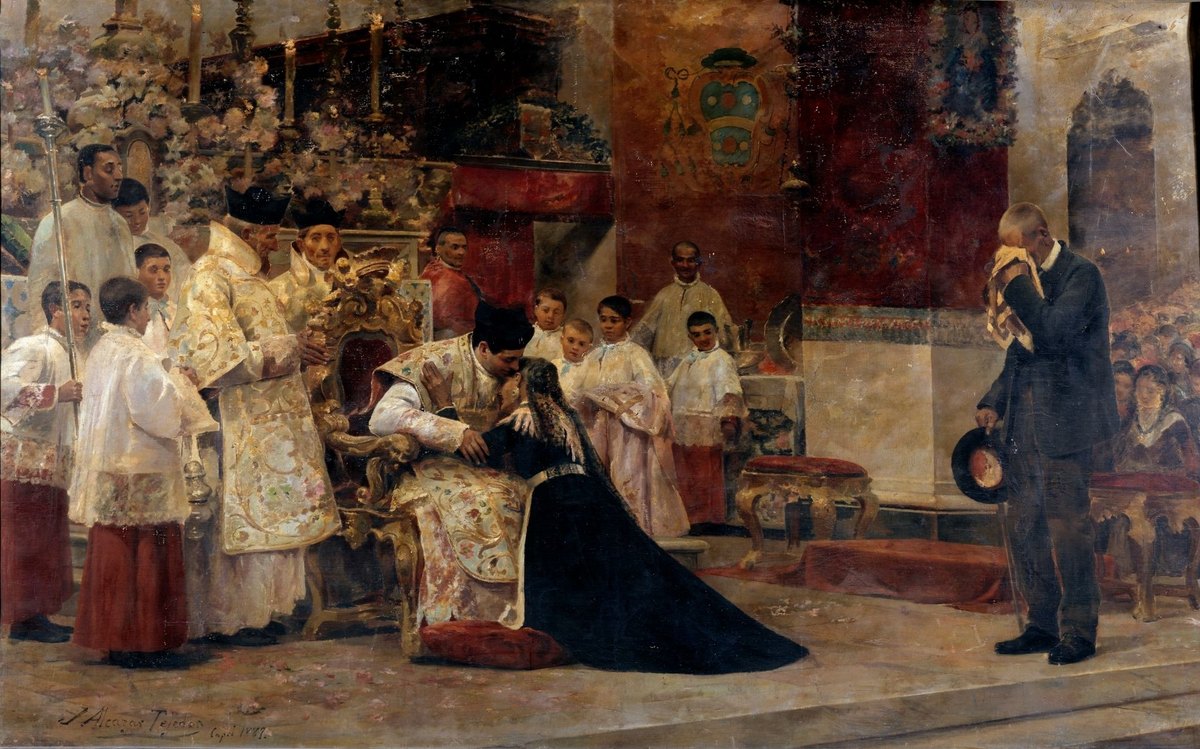
Parents of the Celebrant After His First Mass by José Alcázar Tejedor
$97.92
Type
Size
Frame Color
Quantity
1
Parents of the Celebrant After His First Mass by José Alcázar Tejedor: what it depicts
Parents of the Celebrant after His First Mass by José Alcázar Tejedor
The embrace at the altar
The Mass is over, and the young priest has not yet left the sanctuary. He sits in a heavy gilded armchair, carved with scrolls and topped with a crown-shaped crest, still dressed in the vestments he wore at the altar: a white alb, a cream chasuble embroidered with gold and flowers, and a black biretta. He has bent forward to his mother, who kneels before him on a red cushion. Their faces are pressed together, his eyes closed, and his hand rests on her back.
She is dressed for the occasion in black, with a long train spread across the floor and a black lace mantilla falling from her head over her shoulders. Against the pale, glittering vestments around her she is the darkest shape in the picture, and the eye goes to her first.
The father apart
At the far right, separated from the embrace by an open stretch of floor, stands the father. He is an old man with grey hair, in a plain dark suit and white collar. He holds his hat and a walking cane in one hand, and with the other presses a handkerchief to his eyes. He is weeping. Behind him, at the edge of the canvas, the seated congregation, mostly women, watch the scene from their places.
The Spanish title, Los padres del celebrante después de la misa nueva, names both parents, and Alcázar Tejedor gives each a different response: the mother kneels and holds her son; the father stands back and covers his eyes.
The clergy and the altar boys
The rest of the sanctuary is full of people who have taken part in the Mass. At the left an elderly priest in a gold-embroidered vestment and biretta stands with his hands together beside the chair, and a second priest behind him looks out toward the viewer. Around them are acolytes in red cassocks and white surplices; one holds a tall silver processional staff. Behind the chair a figure in red leans in to watch.
In the centre background a cluster of young altar boys in white surplices, with pale blue ribbons at their collars, look on; one holds a folded pink cloth. A server stands behind them, and nearby are a stool with a red cushion and a silver ewer and basin.
The setting
The high altar rises at the upper left, crowded with tall candles and banks of white and pink flowers. The wall behind the chair is hung with red damask bearing a coat of arms beneath an ecclesiastical hat with hanging tassels, and at the upper right a framed image of the Virgin is garlanded with flowers. Petals are scattered across the sanctuary floor. The painter's signature is at the lower left, with the date 1887.
The painting and the painter
The canvas is very large, 302.5 by 481.5 centimetres, about three metres high and nearly five wide, so the principal figures approach life size. Alcázar Tejedor showed it at Spain's National Exhibition of Fine Arts in 1887, where it won a second-class medal. It belongs to the Museo Nacional del Prado (inventory P007334).
José Alcázar Tejedor was born in Madrid in 1850 and died there in 1907. He studied at the Academia de San Fernando under Federico de Madrazo, with support from the Diputación Provincial of Madrid, then worked in Paris with Vicente Palmaroli and later received funding to study in Rome. He first exhibited at the National Exhibition in 1878 and won a third-class medal there in 1881. Most of his pictures are genre scenes with religious subjects; in 1902 he became a professor at the Escuela de Bellas Artes in Barcelona.
Sources: Wikimedia Commons, File:Los padres del celebrante después de la misa nueva.jpg · Wikidata Q60036842 · Wikipedia, "José Alcázar Tejedor" (English and Spanish) · EcuRed, "José Alcázar Tejedor"
Who Made It
Created by José Alcázar Tejedor. Painted in 1887. Oil on canvas.
More like this: Oil on Canvas
All Available Options
Below is a list of all available sizes and product types.
| Type | Size | Color | Price | Availability |
|---|---|---|---|---|
| Canvas | 18″ x 12″ (Horizontal) | - | $44.13 | In Stock |
| Canvas | 24″ x 16″ (Horizontal) | - | $71.62 | In Stock |
| Canvas | 36" x 24" (Horizontal) | - | $94.11 | In Stock |
| Framed | 18″ x 12″ (Horizontal) | Black | $97.92 | In Stock |
| Framed | 18″ x 12″ (Horizontal) | Espresso | $97.92 | In Stock |
| Framed | 18″ x 12″ (Horizontal) | White | $97.92 | In Stock |
| Framed | 24″ x 16″ (Horizontal) | Black | $121.38 | In Stock |
| Framed | 24″ x 16″ (Horizontal) | Espresso | $121.38 | In Stock |
| Framed | 24″ x 16″ (Horizontal) | White | $121.38 | In Stock |
| Framed | 36" x 24" (Horizontal) | Black | $191.17 | In Stock |
| Framed | 36" x 24" (Horizontal) | Espresso | $191.17 | In Stock |
| Framed | 36" x 24" (Horizontal) | White | $191.17 | In Stock |
Shipping & Returns
All items are custom-made just for you! We partner with trusted print providers for fulfillment. Orders ship in 3-5 business days, with delivery in 5-10 business days.
Reviews
No reviews of Parents of the Celebrant After His First Mass by José Alcázar Tejedor yet — here is what customers say about the prints they bought from us. We invite every customer to write one after their print arrives, and we publish them whether or not they are flattering.
From our customers
- Fantastic print, makes me happy
Arrived great, definitely feels good in the hand & quality frame
Thomas · The Incredulity of Saint Thomas