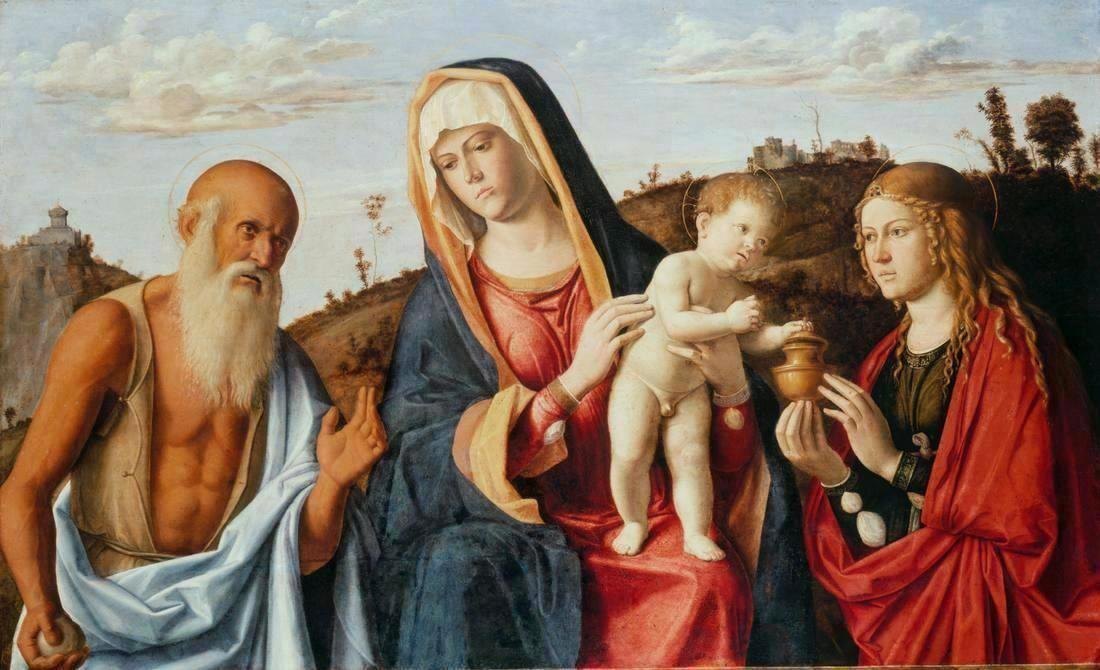
Madonna col Bambino tra S. Geremia e Maria Maddalena by Cima da Conegliano
$101.29
Type
Size
Frame Color
Quantity
1
Madonna col Bambino tra S. Geremia e Maria Maddalena by Cima da Conegliano: what it depicts
Madonna col Bambino tra S. Geremia e Maria Maddalena by Cima da Conegliano
The Artist: Cima da Conegliano
Cima da Conegliano, born Giovanni Battista Cima around 1459 in Conegliano, Veneto, is celebrated as one of the foremost painters of the Venetian Renaissance. Active primarily in the late 15th and early 16th centuries, Cima was known for his serene religious subjects, luminous landscapes, and innovative use of color and light. His style bridges the tradition of Venetian colorism with the evolving ideals of Renaissance naturalism. Cima’s works are notable for their clarity and calm, and he played a pivotal role in the transmission of stylistic innovations from Venice to the wider Venetian territories. While overshadowed in later centuries by contemporaries such as Giovanni Bellini and Giorgione, Cima’s body of work has attracted renewed scholarly interest for its subtle lyricism and spiritual depth.
Historical Context
"Madonna col Bambino tra S. Geremia e Maria Maddalena" (Madonna and Child between St. Jeremiah and Mary Magdalene) was painted around 1495. This period marked a turning point for Venetian art. Venice, a wealthy maritime republic, was experiencing a flourishing of the arts, driven by economic prosperity and a growing appetite for devotional images. The city’s painters were experimenting with new techniques in oil, brought north from the Netherlands, and exploring the emotional nuances of sacred themes. The period also saw a rise of private commissions, as religious devotion became increasingly personal and domestic.
Painted in oil on panel, Cima’s work is representative of this transitional era in Venetian art. The use of oil allowed for subtler gradations of tone and greater luminosity, which Cima exploited to deepen the spiritual and atmospheric qualities of his altarpieces and private devotional works.
Religious and Cultural Significance
The subject of the Virgin and Child flanked by saints was a mainstay of Renaissance devotional art, known as a "sacra conversazione" (holy conversation). This format reflected the humanistic ideals of the period, bringing together divine and human figures in a harmonious, approachable setting. The inclusion of St. Jeremiah—a relatively uncommon figure in Renaissance art—alongside the more familiar Mary Magdalene, underscores the breadth of Cima’s spiritual vision and his patrons’ specific devotions.
For contemporary viewers, devotional paintings like this one served a dual purpose: they were objects of veneration, designed to aid prayer and contemplation, and statements of civic or family pride. The gentle presence of the Madonna and Christ Child, surrounded by saints, would have reassured viewers of divine intercession and protection.
Symbolism and Iconography
In "Madonna col Bambino tra S. Geremia e Maria Maddalena", each figure was meticulously chosen and imbued with meaning:
- The Madonna and Child: Central and serene, the Madonna holds the Christ Child standing on her lap, an archetype of maternal care and divine love. The Child’s gesture—reaching towards the Magdalene’s ointment jar—manifests Christ’s role as the Redeemer.
- St. Jeremiah: Typically depicted as an elderly prophet, Jeremiah appears here half-clad, with a long white beard and an austere expression. His presence could signal a particular connection to the commissioning community or offer a meditation on prophecy and fulfillment.
- Mary Magdalene: Frequently portrayed with flowing hair and an ointment jar, Mary Magdalene is symbolic of repentance and divine forgiveness. Her prominent inclusion reflects the growing Renaissance interest in personal transformation and the power of grace.
Other subtle symbols—such as the landscape, gestures, and colors—contribute to the painting’s layers of meaning. The lush Venetian landscape that often appears in Cima’s backgrounds alludes to paradise and the world’s renewal in Christ. The calm symmetry and gentle gazes invite introspection and devotional intimacy.
Artistic Techniques
Cima da Conegliano was highly regarded for his delicate use of oil paint, which he handled with an exceptional clarity and brightness. In this painting, the artist’s mastery is evident in several key aspects:
- Color and Light: Cima’s palette is characterized by clear, radiant hues and a soft gradation of light, hallmark traits of Venetian painting. His depiction of flesh and drapery is luminous and tactile, creating a sense of ethereal presence.
- Compositional Harmony: The arrangement of figures in a balanced, triangular composition echoes the Renaissance pursuit of harmony and order. The figures are solid yet gentle, avoiding the exaggerated dynamism seen in later Mannerism.
- Landscape Integration: Cima’s skillful incorporation of landscape, possibly inspired by his Veneto roots, lends his works a sense of peace and spatial depth. The settings are not mere backdrops, but integral to the emotional tone of the painting.
- Soft Modeling: Using the flexibility of oil paint, Cima achieves subtle transitions in shadow and light, enhancing the sense of volume and presence. The calm expressions and naturalistic gestures of the figures underscore their accessibility and spiritual appeal.
Cultural Impact
Though less known than some of his Venetian counterparts, Cima da Conegliano’s works significantly influenced the devotional art of his generation and beyond. His clarity of vision, balanced compositions, and mastery of light helped shape the direction of Venetian painting in the early 16th century.
"Madonna col Bambino tra S. Geremia e Maria Maddalena" exemplifies the thoughtful spirituality and technical virtuosity that defined Cima’s oeuvre. Today, the painting is appreciated not only for its devotional beauty but also as a window into the piety, artistic innovation, and social dynamics of Renaissance Venice.
The piece continues to be studied for its nuanced iconography.
Sources
- Goffen, Rona. Giovanni Bellini. Yale University Press, 1989.
- Humfrey, Peter. Cima da Conegliano. Cambridge University Press, 1983.
- Olson, Roberta J. M. "Cima da Conegliano." Grove Art Online. Oxford University Press.
- The National Gallery, London. "Cima da Conegliano" (online collection and resources).
Who Made It
Created by Cima da Conegliano. Painted in 1495. Olio su tavola.
More like this: Madonna and Child, Virgin Mary, Mary Magdalene
All Available Options
Below is a list of all available sizes and product types.
| Type | Size | Color | Price | Availability |
|---|---|---|---|---|
| Canvas | 20" x 10" (Horizontal) | - | $53.18 | In Stock |
| Framed | 20" x 10" (Horizontal) | Black | $101.29 | In Stock |
| Framed | 20" x 10" (Horizontal) | Espresso | $101.29 | In Stock |
| Framed | 20" x 10" (Horizontal) | White | $101.29 | In Stock |
Image: source, Public domain.
Shipping & Returns
All items are custom-made just for you! We partner with trusted print providers for fulfillment. Orders ship in 3-5 business days, with delivery in 5-10 business days.
Reviews
No reviews of Madonna col Bambino tra S. Geremia e Maria Maddalena by Cima da Conegliano yet. We invite every customer to write one after their print arrives, and we publish them whether or not they are flattering.