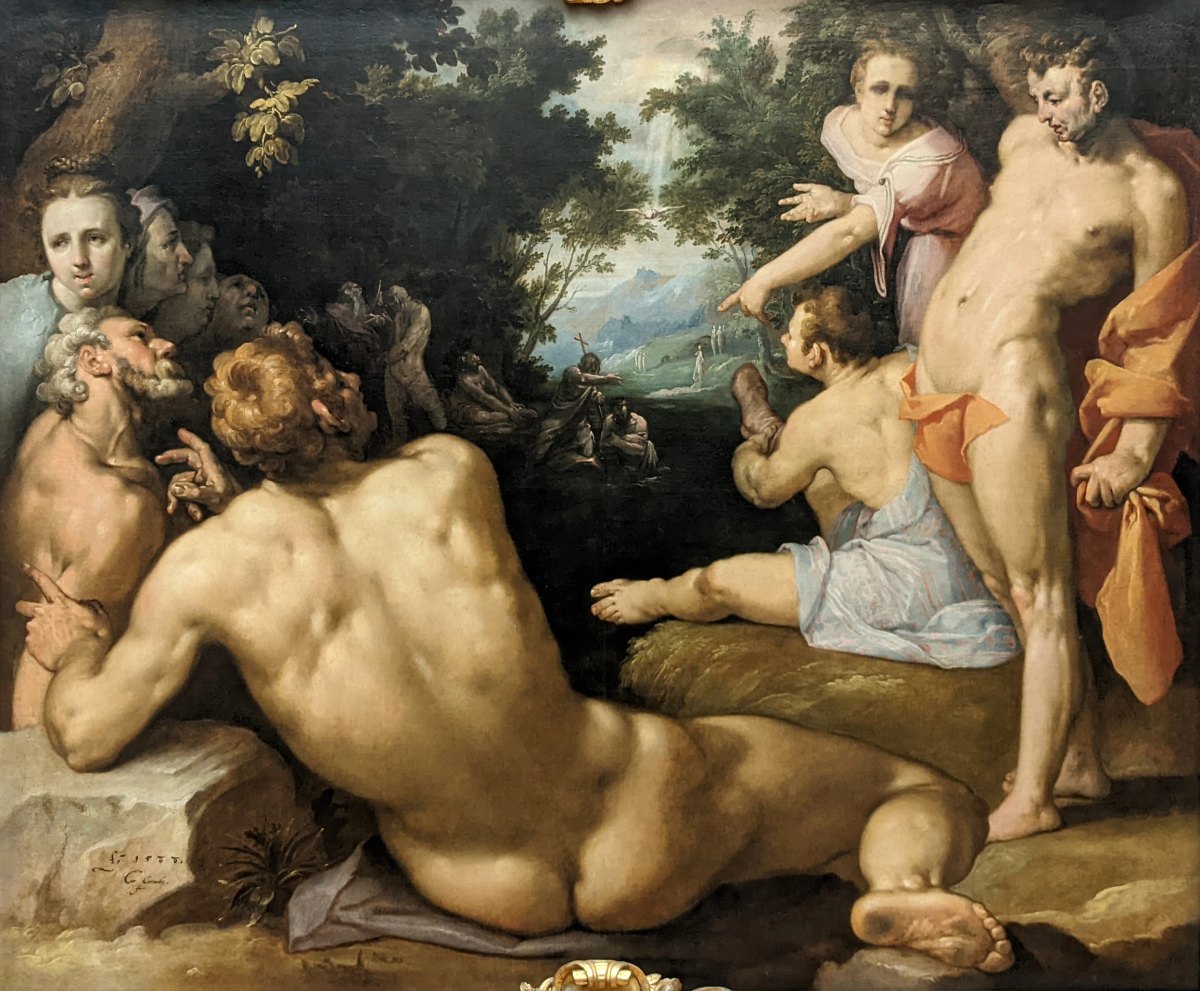
The Baptism of Christ by Cornelis van Haarlem
$56.29
Type
Size
Frame Color
Quantity
1
The Baptism of Christ by Cornelis van Haarlem: what it depicts
The Baptism of Christ by Cornelis van Haarlem
Artist Background and Significance
Cornelis van Haarlem (1562–1638) was a pivotal figure in the development of Dutch Mannerism, a style marked by its elegant forms, dramatic compositions, and complex figure arrangements. Born in Haarlem, Netherlands, van Haarlem trained under Pieter Pietersz and later, in Antwerp, Gillis Coignet, whose exposure to Italian Renaissance influences shaped his mature style. Cornelis was a founding member of the Haarlem Academy, an informal drawing academy that played a crucial role in shaping the Northern Netherlands’ artistic scene, connecting him with contemporaries such as Hendrick Goltzius and Karel van Mander—together forming what became known as the Haarlem Mannerists.
Van Haarlem was renowned for his large historical and mythological canvases filled with muscular, often nude figures in dramatic poses. His work stands as a bridge between the High Renaissance’s harmony and the emerging Baroque’s emotional intensity. Among his many religious subjects, "The Baptism of Christ" is a significant example of his technique, spirituality, and iconographic richness.
Historical Context of the Artwork
"The Baptism of Christ" was painted at a time of religious reformation and political upheaval in the Dutch Republic. The Dutch Revolt against Spanish Catholic rule influenced the themes and commissions of the time, with Protestant patrons increasingly supporting religious art that emphasized personal faith and biblical narrative.
This period also saw a fusion between Northern European naturalism and the stylized, idealized figures of Italian art—an influence directly visible in van Haarlem’s work. Religious imagery like "The Baptism of Christ" served both church and civic patrons, reflecting a didactic purpose in educating viewers about scriptural events and values within a turbulent society.
Religious and Cultural Significance
The theme of Christ’s baptism is central in Christian art, marking the beginning of Jesus’ public ministry and symbolizing purification, renewal, and the affirmation of Christ’s divine sonship. According to the Gospel accounts, John the Baptist baptized Jesus in the river Jordan, after which the Holy Spirit descended upon Him as a dove, and a voice proclaimed Jesus as the beloved Son of God.
In van Haarlem’s Protestant context, scenes like the baptism exemplified the importance of faith over ritual, yet retained iconography that addressed universal Christian beliefs. Paintings such as this acted as visual sermons, reminding viewers of the transformative power of baptism not only as a rite but as an inward, spiritual experience.
Symbolism and Iconography
Van Haarlem’s rendering of “The Baptism of Christ” brims with symbolic elements, each contributing to the painting’s spiritual gravitas:
- The Dove: The descending dove is the traditional symbol of the Holy Spirit, echoing the Gospel account and indicating divine presence and blessing.
- The River Jordan: The baptismal water represents both physical and spiritual cleansing, and, more broadly, the passage from old to new life in Christ.
- Heavenly Light: Often, Mannerist painters like van Haarlem would employ a dramatic shaft of light or a celestial break in the clouds, signifying God the Father’s proclamation and approval.
- Gesture and Posture: John the Baptist is shown with a calm, reverent demeanor, his pouring hand focused on Christ’s head. Christ is often depicted either bowing or with hands clasped in prayer, signifying humility and acceptance of His mission.
- Figures and Clothing: The partial nudity of Christ alludes to innocence and the vulnerability of humanity, while John’s coarse garment highlights his ascetic life and role as the last prophet of the Old Testament.
Artistic Techniques Used
Cornelis van Haarlem’s approach to “The Baptism of Christ” reflects his command of the Mannerist style:
- Elongated Anatomy: Figures are elongated and gracefully posed, emphasizing ideal beauty and spiritual elevation, a hallmark of Mannerism.
- Complex Composition: The arrangement draws the viewer’s eye toward the central sacramental act, using a pyramidal grouping to add stability and focus within the dynamic movement.
- Vivid Colors and Light: Van Haarlem employs vibrant hues to distinguish the spiritual event from the natural world, while modulated light adds a lyrical, otherworldly quality.
- Naturalistic Details: Despite stylization, careful attention is paid to the landscape (trees, flowing water), suggesting the artist’s Northern heritage of closely observed nature.
Van Haarlem’s brushwork is precise, displaying his training in both oil technique and the meticulous preparation favored by Northern artists. Layering and glazing create depth, especially in the rendering of flesh and drapery, enhancing the figures’ sculptural qualities.
Cultural Impact
“The Baptism of Christ” by Cornelis van Haarlem serves as a key example of late sixteenth-century religious painting in the Dutch Republic. The work bridges Catholic and Protestant traditions, using familiar iconography to communicate new theological ideas in a society negotiating religious transformation.
Later Dutch artists, including Rembrandt, would reinterpret biblical themes with greater emotional realism. Van Haarlem’s clarity of narrative, sophisticated compositions, and technical virtuosity contributed to raising the status of history painting within Dutch art, at a time when genre landscapes and portraiture were gaining prominence.
Moreover, the painting reflects the personal devotional climate of early modern Holland, where art’s purpose extended beyond church decoration, stimulating private contemplation and scriptural engagement. As such, “The Baptism of Christ” remains not only a masterwork of Mannerism but a testament to the enduring power of religious art in shaping cultural and spiritual identities.
Sources
- Liedtke, Walter. Dutch Paintings in the Metropolitan Museum of Art. The Metropolitan Museum of Art, 2007.
- Meijer, Bert W. "Cornelis van Haarlem," Grove Art Online, Oxford Art Online.
- Schama, Simon. The Embarrassment of Riches: An Interpretation of Dutch Culture in the Golden Age. Vintage, 1997.
- The Netherlands Institute for Art History (RKD) – Entry on Cornelis van Haarlem.
Who Made It
Created by Cornelis van Haarlem.
More like this: Baptism of Christ, Jesus Christ, Saint John the Baptist
All Available Options
Below is a list of all available sizes and product types.
| Type | Size | Color | Price | Availability |
|---|---|---|---|---|
| Canvas | 10" x 8" (Horizontal) | - | $31.52 | In Stock |
| Canvas | 14″ x 11″ (Horizontal) | - | $37.49 | In Stock |
| Canvas | 20" x 16" (Horizontal) | - | $53.71 | In Stock |
| Canvas | 24" x 20" (Horizontal) | - | $96.36 | In Stock |
| Canvas | 30" x 24" (Horizontal) | - | $113.39 | In Stock |
| Framed | 10″ x 8″ (Horizontal) | Black | $56.29 | In Stock |
| Framed | 10″ x 8″ (Horizontal) | Espresso | $56.29 | In Stock |
| Framed | 10″ x 8″ (Horizontal) | White | $56.29 | In Stock |
| Framed | 14″ x 11″ (Horizontal) | Black | $73.88 | In Stock |
| Framed | 14″ x 11″ (Horizontal) | Espresso | $73.88 | In Stock |
| Framed | 14″ x 11″ (Horizontal) | White | $73.88 | In Stock |
| Framed | 20″ x 16″ (Horizontal) | Black | $109.97 | In Stock |
| Framed | 20″ x 16″ (Horizontal) | Espresso | $109.97 | In Stock |
| Framed | 20″ x 16″ (Horizontal) | White | $109.97 | In Stock |
| Framed | 24" x 20" (Horizontal) | Black | $140.18 | In Stock |
| Framed | 24" x 20" (Horizontal) | Espresso | $140.18 | In Stock |
| Framed | 24" x 20" (Horizontal) | White | $140.18 | In Stock |
| Framed | 30" x 24" (Horizontal) | Black | $205.49 | In Stock |
| Framed | 30" x 24" (Horizontal) | Espresso | $205.49 | In Stock |
| Framed | 30" x 24" (Horizontal) | White | $205.49 | In Stock |
Image: source, CC BY-SA 4.0.
Shipping & Returns
All items are custom-made just for you! We partner with trusted print providers for fulfillment. Orders ship in 3-5 business days, with delivery in 5-10 business days.
Reviews
No reviews of The Baptism of Christ by Cornelis van Haarlem yet — here is what customers say about the prints they bought from us. We invite every customer to write one after their print arrives, and we publish them whether or not they are flattering.
From our customers
- Fantastic print, makes me happy
Arrived great, definitely feels good in the hand & quality frame
Thomas · The Incredulity of Saint Thomas