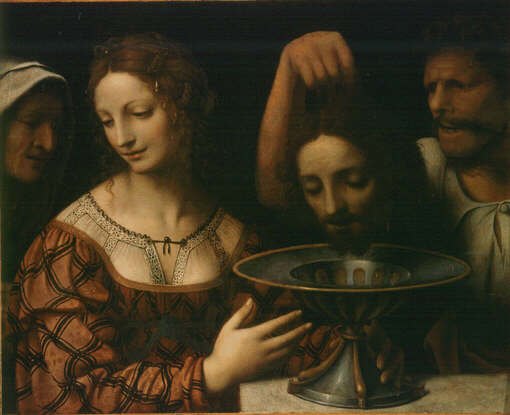
Salome with the Head of John the Baptist by Bernardino Luini
$56.29
Type
Size
Frame Color
Quantity
1
Salome with the Head of John the Baptist by Bernardino Luini: what it depicts
Bernardino Luini: An Influential Figure of the Italian Renaissance
Bernardino Luini, active during the early 16th century, stands as a notable figure of the Lombard school, celebrated for his refined use of color and harmonious compositions. Born around 1480 in Lombardy, Luini’s work was profoundly influenced by Leonardo da Vinci, whose artistic principles permeated Lombardy after Leonardo’s Milanese period. Luini’s oeuvre elegantly bridges High Renaissance ideals and the distinct softness of northern Italian painting.
While his contemporaries—such as Leonardo and Raphael—achieved greater fame, Luini was recognized for his serene Madonnas, graceful figures, and sensitive renderings of religious subjects. His position in the art historical canon underscores both the collaborative milieus of Renaissance workshops and the nuanced regional variations within Italian art of the sixteenth century.
Historical Context of “Salome with the Head of John the Baptist”
Painted around 1527, “Salome with the Head of John the Baptist” exemplifies the fascination with biblical and dramatic themes that permeated Renaissance art. The tale of Salome originates from the Gospels; Salome, urged by her mother Herodias, requests the head of John the Baptist as a reward for her dance before King Herod. The story’s rich narrative complexity—mixing themes of desire, vengeance, and martyrdom—was a favored subject across European painting.
The political and spiritual climate of early 16th-century Milan contributed to a surge in religious commissions, often designed for private devotion. Luini’s version, executed in oil on panel, reflects both the tastes and the pious concerns of his patrons, evoking meditation on virtue, vice, and sacrifice.
Religious and Cultural Significance
The story of John the Baptist’s beheading holds deep resonance within Christian tradition. John the Baptist is venerated as the forerunner of Christ, and his martyrdom represents the triumph of faith over temporal corruption and sin. In painting Salome’s story, Luini participated in a long-standing artistic practice of interpreting biblical narratives not only as cautionary tales but also as meditative aids for viewers.
Culturally, the depiction of Salome became a site for negotiating anxieties about morality, female agency, and the consequences of unchecked desire. Renaissance viewers, well-versed in biblical stories, would perceive Luini’s painting as both a moralized narrative and a demonstration of artistic virtuosity.
Symbolism and Iconography in Luini’s Painting
Luini’s “Salome with the Head of John the Baptist” is distinguished by its subtle and evocative symbolism. The central figures—Salome, John, and often the executioner—are composed with a restraint that contrasts the violence of the subject. Salome is usually depicted delicately holding a platter with John’s severed head, her demeanor serene or contemplative, heightening the psychological complexity of the scene.
The presentation of John’s head references both sacramental imagery and classical motifs. The platter, resembling a Eucharistic paten, alludes to sacrifice and martyrdom. Salome’s finery, rendered through Luini’s delicate brushwork, can be viewed as an emblem of vanity or worldly temptation, while John’s facial expression, often peaceful rather than tormented, suggests his spiritual purity and acceptance.
Light and color play a symbolic role as well. Luini bathed the scene in a gentle, almost ethereal light, reinforcing the spiritual dimension of the narrative. The figures’ interlocking gazes and gestures encourage the viewer to contemplate both the tragedy and the transcendence inherent in the biblical story.
Artistic Techniques: Oil on Panel Mastery
Luini’s technical approach in “Salome with the Head of John the Baptist” demonstrates his mastery of oil painting, especially on wood panel—a popular medium during the Renaissance for its smooth surface and durability. Inspired by Leonardo, Luini employed soft chiaroscuro, blending light and shadow to model forms gently and create atmospheric effects.
His application of oil paint allowed for nuanced gradations of color and tone, imbuing flesh, fabric, and background with a luminous quality. The faces are painted with a careful sfumato, echoing Leonardo’s innovation, while the composition maintains a harmonious balance between narrative clarity and decorative detail.
Luini’s sensitivity to gesture and expression sets his work apart. The emotional restraint he conveys, paired with the tactile richness of his surfaces—such as the sheen of Salome’s attire and the subtle transitions on John’s lifeless face—create a painting at once meditative and sensually engaging.
The Cultural Impact and Legacy of Luini’s “Salome”
Though eclipsed in his day by more famous contemporaries, Luini’s influence was significant in shaping the Milanese painting style for generations. “Salome with the Head of John the Baptist” was admired for its psychological depth and technical refinement.
In a broader cultural sense, Luini’s vision of Salome contributed to the complex legacy of the story in Western art—alternately as a symbol of fatal beauty, martyrdom, or the dynamics of power and innocence. His interpretation, marked by empathy and restraint, helped fortify the Renaissance ideal of merging moral instruction with artistic pleasure.
Exhibitions and scholarly studies in the twentieth and twenty-first centuries have underscored Luini’s contributions to Italian art, particularly his unique ability to synthesize Leonardesque gravitas with local artistic traditions. The enduring appeal of his “Salome” lies in its ability to invite viewers into a world at once historical, spiritual, and profoundly human.
Sources
- Welch, Evelyn. Art and Authority in Renaissance Milan. Yale University Press, 1995.
- Freedberg, Sydney J. Painting in Italy, 1500-1600. Penguin Books, 1971.
- Gallerie degli Uffizi, Florence: Bernardino Luini – Salome with the Head of John the Baptist
Who Made It
Created by Bernardino Luini. Painted in 1527. oil on panel.
More like this: Martyrdom, Saint John the Baptist, Renaissance
All Available Options
Below is a list of all available sizes and product types.
| Type | Size | Color | Price | Availability |
|---|---|---|---|---|
| Canvas | 10" x 8" (Horizontal) | - | $31.52 | In Stock |
| Framed | 10″ x 8″ (Horizontal) | Black | $56.29 | In Stock |
| Framed | 10″ x 8″ (Horizontal) | Espresso | $56.29 | In Stock |
| Framed | 10″ x 8″ (Horizontal) | White | $56.29 | In Stock |
Image: source, CC BY-SA 4.0.
Shipping & Returns
All items are custom-made just for you! We partner with trusted print providers for fulfillment. Orders ship in 3-5 business days, with delivery in 5-10 business days.
Reviews
No reviews of Salome with the Head of John the Baptist by Bernardino Luini yet — here is what customers say about the prints they bought from us. We invite every customer to write one after their print arrives, and we publish them whether or not they are flattering.
From our customers
- Fantastic print, makes me happy
Arrived great, definitely feels good in the hand & quality frame
Thomas · The Incredulity of Saint Thomas