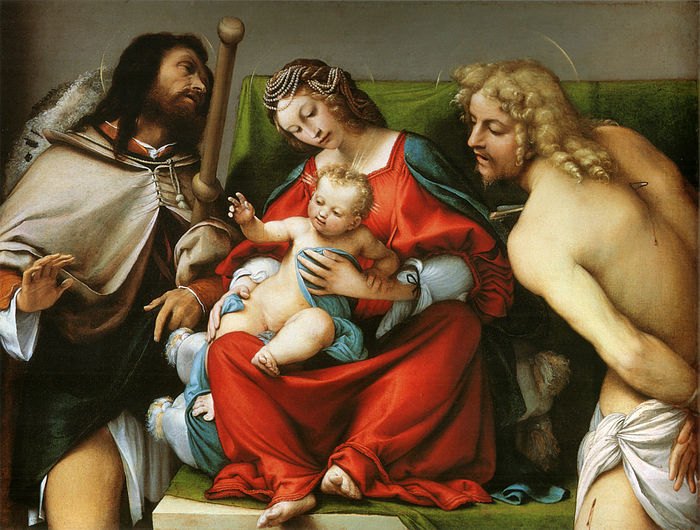
Madonna and Child with Saint Roch and Saint Sebastian by Lorenzo Lotto
$140.18
Type
Size
Frame Color
Quantity
1
Madonna and Child with Saint Roch and Saint Sebastian by Lorenzo Lotto: what it depicts
Madonna and Child with Saint Roch and Saint Sebastian by Lorenzo Lotto
Lorenzo Lotto: The Artist’s Background and Significance
Lorenzo Lotto, born around 1480 in Venice, was one of the most distinctive and underappreciated painters of the Italian Renaissance. Bridging the stylistic innovations of the Venetian school and the realism emerging from central Italy, Lotto brought a unique psychological insight and emotional intensity to his works. As an artist, he was deeply influenced by contemporaries such as Giovanni Bellini and Albrecht Dürer, yet his career was marked by frequent moves across Northern Italy—Bergamo, Treviso, and eventually the Marche—where he developed a personal style, marked by vivid color, dramatic composition, and psychological depth.
Despite his prolific output, Lotto operated on the fringes of mainstream artistic centers like Venice and Florence, which led to both a certain freedom in his approach and, unfortunately, less recognition during his lifetime. He was an innovator in portraiture and religious art, and his works are revered today for their humanity, intimate spiritualism, and narrative subtlety.
Historical Context of the Artwork
Madonna and Child with Saint Roch and Saint Sebastian was painted during the early 16th century, a time when Italy was regularly beset by outbreaks of plague and social upheaval resulting from both political strife and economic uncertainty. The popularity of protective saints such as Roch (Rocco) and Sebastian grew during this period, as communities looked for spiritual intercession in times of crisis. This painting emerges from the intersection of intense religious devotion, social anxiety, and the Renaissance’s reverence for humanistic representation.
Lotto’s commissions were frequently tied to the civic and spiritual needs of small towns and confraternities outside Venice—places seeking reassurance through religious imagery. Madonna and Child with Saint Roch and Saint Sebastian, however, was a private commission: Lotto painted it in Bergamo for Battista Cucchi, a surgeon, for his own devotion.
Religious and Cultural Significance
The painting belongs to a long tradition of Sacra Conversazione—a sacred conversation—where the Madonna and Child are depicted in the company of saints. These images were popular in altarpieces and private devotional works across Italy. Saint Roch and Saint Sebastian, prominent in this painting, were especially revered as protectors against the plague.
- Saint Roch (left) was renowned for his miraculous healings and the wounds on his thigh, often interpreted as signs of divine protection and empathy for the afflicted.
- Saint Sebastian (right), depicted enduring martyrdom by arrows, symbolized both suffering and salvation, serving as a powerful intercessor during times of pestilence.
The presence of these saints alongside the Madonna and Child reassured viewers of divine compassion, protection, and the promise of redemption, contributing to a sense of community resilience in the face of hardship.
Symbolism and Iconography
Lotto’s painting is replete with spiritual and visual symbolism:
- Madonna and Child: Central to the composition, the Virgin Mary cradles the infant Jesus, embodying both maternal tenderness and the incarnation of divine mercy.
- Saint Roch: Traditionally depicted revealing a plague sore on his thigh, he often holds a pilgrim’s staff and is accompanied by a dog, symbolizing charity, faith, and hope for healing.
- Saint Sebastian: Shown with his body pierced by arrows, Sebastian is a symbol of resilience against suffering, the arrows alluding to the plague’s scourge and divine intervention against it.
- Setting: There is no landscape here; the Virgin sits on a plain stone seat against a green cloth and a grey wall, with the saints pressed close on either side, bringing the holy figures near to the viewer’s world.
Lotto’s use of gesture and gaze creates communicative lines among the figures, drawing the viewer into the emotional and spiritual dialogue—an invitation to personal devotion and empathy.
Artistic Techniques Used
Lotto’s approach in this oil on canvas painting is notable for several key techniques:
- Color and Light: Deep, luminescent colors and refined tonal modulations enhance the figures’ three-dimensionality. Lotto favored clear, luminous hues which contribute to the spiritual atmosphere of the painting.
- Composition: The figures are arranged in a close, horizontal row, with the Virgin at the centre, guiding the viewer’s attention toward the Madonna and Child as the focal point.
- Expressiveness: Lotto’s figures are often imbued with palpable psychological presence. The saints and the Virgin often show subtle emotions—concern, hope, compassion—underscoring Lotto’s gift for humanizing the divine.
- Detailing: Minute attention to textures—fabrics, hair, skin, and landscape elements—reflects Lotto’s careful observation and technical mastery.
These techniques work together to create a space that is at once transcendent and intimately accessible, merging spiritual solemnity with everyday humanity.
Cultural Impact
While not as widely celebrated as the works of Titian or Raphael, Madonna and Child with Saint Roch and Saint Sebastian exemplifies a trend during the Italian Renaissance toward emotional engagement and spiritual immediacy in religious art. Lotto’s religious paintings, including this one, influenced later generations’ approach to narrative depth and psychological realness in sacred painting.
Modern scholarship has reassessed Lotto’s contribution, seeing him as a precursor to later developments in Baroque naturalism and portraiture, valuing his empathy and individuality. His depictions of saints and the Madonna as approachable and emotionally resonant figures resonate with present-day viewers and underscore the enduring human need for spiritual reassurance amid crisis—a message that continues to be relevant.
Sources
- National Gallery of Canada, Ottawa. "Lorenzo Lotto: Madonna and Child with Saints Roch and Sebastian."
- Zuffi, Stefano. Lorenzo Lotto. Mondadori Arte, 2004.
- Brown, David Alan, Peter Humfrey and Mauro Lucco. Lorenzo Lotto: Rediscovered Master of the Renaissance. National Gallery of Art, Washington, 1997.
- Humfrey, Peter. Lorenzo Lotto. Yale University Press, 1997.
- Web Gallery of Art. "Madonna and Child with Saints, Lotto, Lorenzo."
Who Made It
Created by Lorenzo Lotto. Painted in 1518. Oil on canvas.
More like this: Madonna and Child, Virgin Mary, Saint Sebastian, Renaissance
All Available Options
Below is a list of all available sizes and product types.
| Type | Size | Color | Price | Availability |
|---|---|---|---|---|
| Canvas | 10" x 8" (Horizontal) | - | $31.52 | In Stock |
| Canvas | 12" x 9" (Horizontal) | - | $32.98 | In Stock |
| Canvas | 14″ x 11″ (Horizontal) | - | $37.49 | In Stock |
| Canvas | 16″ x 12″ (Horizontal) | - | $45.19 | In Stock |
| Framed | 20" x 24" (Vertical) | Black | $140.18 | In Stock |
| Framed | 20" x 24" (Vertical) | Espresso | $140.18 | In Stock |
| Framed | 20" x 24" (Vertical) | White | $140.18 | In Stock |
Image: source, CC BY-SA 4.0.
Shipping & Returns
All items are custom-made just for you! We partner with trusted print providers for fulfillment. Orders ship in 3-5 business days, with delivery in 5-10 business days.
Reviews
No reviews of Madonna and Child with Saint Roch and Saint Sebastian by Lorenzo Lotto yet. We invite every customer to write one after their print arrives, and we publish them whether or not they are flattering.