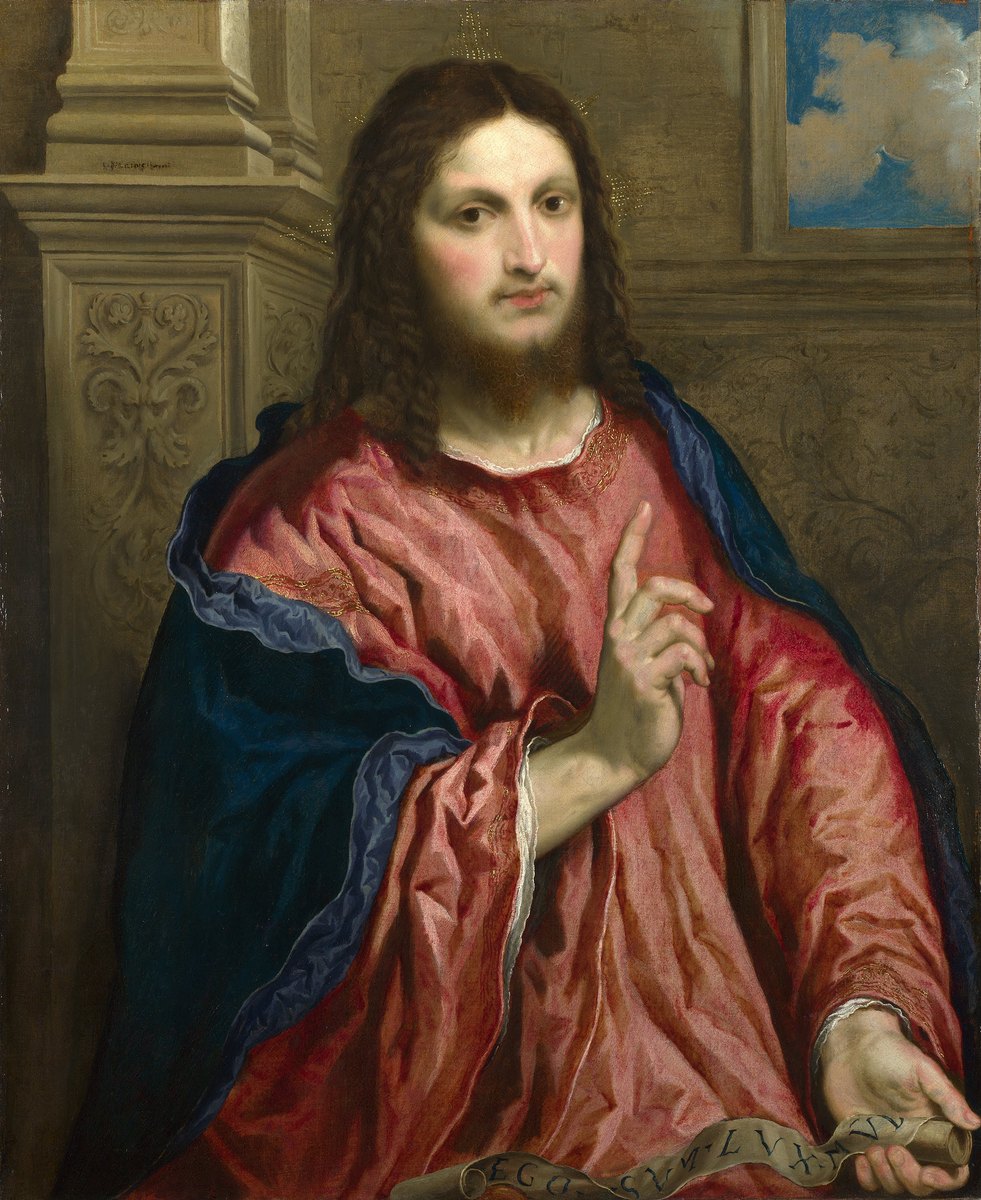
Christ as 'The Light of the World' by Paris Bordone
$56.29
Type
Size
Frame Color
Quantity
1
Christ as 'The Light of the World' by Paris Bordone: what it depicts
Christ as "The Light of the World" by Paris Bordone
Artist’s Background and Significance
Paris Bordone (1500–1571) was a prominent Venetian painter whose career bridged the High Renaissance and Mannerist epochs. A pupil of Titian, Bordone absorbed the lush colors and dramatic compositions associated with the Venetian school. Although initially overshadowed by his master and contemporaries, Bordone’s work is now recognized for its dynamic compositions, intense emotionalism, and refined use of color. Operating primarily in Venice, Bordone also gained commissions in France and Northern Italy, securing his reputation as a versatile and influential painter.
Historical Context of the Artwork
"Christ as 'The Light of the World'" was painted during a period of significant religious upheaval and transformation in Europe, most likely around the mid-16th century. The Roman Catholic Church was responding to the Protestant Reformation, and art served as a critical tool for reaffirming core doctrines and asserting the glory of Christ. In Venice, religious imagery thrived, serving both liturgical and didactic functions. Within this environment, Bordone’s painting reflects not just artistic accomplishment, but theological engagement—reaffirming Christ’s divinity and role as the spiritual illuminator of humanity.
Religious and Cultural Significance
The title "Christ as 'The Light of the World'" references a defining statement attributed to Jesus in the Gospel of John: “I am the light of the world. Whoever follows me will never walk in darkness, but will have the light of life” (John 8:12). Such a portrayal carries immense religious resonance. For centuries, light has symbolized truth, purity, and salvation within Christianity. In Bordone’s hands, Christ is not merely a teacher or prophet but the ultimate source of divine illumination, responsible for guiding souls from sin and ignorance toward spiritual fulfillment.
The painting would have inspired the faithful, reinforcing messages about Christ’s centrality and the promise of redemption through Him. In a climate marked by doctrinal conflict and spiritual anxiety, Bordone’s vision of Christ as the eternal light reassured viewers of the persistence of divine grace and the Church’s redemptive mission.
Symbolism and Iconography
Bordone’s composition is rich with symbolic meaning. Christ faces the viewer, a faint halo of rays about his head, his right hand raised and his left holding a scroll inscribed with the words “Ego sum lux”—establishing Him as both physically present and metaphysically transcendent. The handling of light is pivotal, visually enacting the theological affirmation of His statement.
Key iconographic features often included in Bordone's religious works may be observed:
- The halo: A traditional signifier of holiness and divinity, sometimes rendered as a subtle nimbus or more pronounced aureole, emphasizing Christ’s unique status.
- The gesture: Christ’s hand may be raised in benediction or in a teaching gesture, underscoring his dual roles as guide and redeemer.
- The surroundings: The setting might be subdued and dark, contrasting dramatically with Christ’s luminosity, and heightening the metaphor of light in darkness.
- Book or scroll: Frequently included to connote divine wisdom and the fulfillment of prophecy.
These elements work in concert to portray Christ not only as a historical figure but as the living Word, active and present in the believer’s world.
Artistic Techniques Used
Bordone’s Venetian heritage is evident in his lavish approach to color and texture. With "Christ as 'The Light of the World'," he deployed chiaroscuro—a technique that uses strong contrasts between light and dark to produce a sense of volume and depth. The luminous depiction of Christ emerges as the compositional and spiritual focal point.
Bordone’s brushwork is fluid and confident, lending a palpable sense of immediacy and intimacy to the sacred subject. The skin tones are blended delicately to convey a lifelike physicality, yet the effect of the radiant light suggests the otherworldly.
The painter’s subtle gradation of light, likely achieved with glazes and layering typical of the Venetian style, envelops the figure in a glow that transcends mere natural illumination, heightening the symbolic resonance. Bordone’s expert rendering of fabric, flesh, and atmosphere further imbues the work with richness and vitality.
Cultural Impact
"Christ as 'The Light of the World'" has endured as a powerful devotional image, influencing how subsequent generations interpreted and envisioned the divinity of Christ. Bordone’s synthesis of dramatic visual effects and deep theological content would resonate with both clergy and laity, reinforcing the use of religious painting as a form of visual theology.
The motif of Christ as the bringer of light enjoyed broad popularity in both Western and Eastern Christian traditions; Bordone’s interpretation, in particular, exemplifies the Venetian capacity to merge spiritual ideals with sensuous beauty. His work played a role in the broader Counter-Reformation effort to use art as an instrument of spiritual persuasion and instruction, as well as artistic delight.
Later artists continued to return to the theme, underlining its enduring potency.
As an exemplar of Renaissance religious art, Bordone’s "Christ as 'The Light of the World'" continues to be studied for its theological depth, technical virtuosity, and historical value, embodying the central message of hope and illumination that defines much of Christian doctrine.
Sources
- Humfrey, Peter. Painting in Renaissance Venice. Yale University Press, 1995.
- Freedberg, Sydney J. Painting in Italy, 1500–1600. Yale University Press, 1993.
- The J. Paul Getty Museum. "Paris Bordone," artist biography and analysis.
- National Gallery (London), "Christ as 'The Light of the World'" by Paris Bordone.
- New Catholic Encyclopedia. "Light, Symbolism of."
Who Made It
Created by Paris Bordone. Painted in 1550.
More like this: Jesus Christ, Saints
All Available Options
Below is a list of all available sizes and product types.
| Type | Size | Color | Price | Availability |
|---|---|---|---|---|
| Canvas | 8″ x 10″ (Vertical) | - | $31.52 | In Stock |
| Canvas | 11″ x 14″ (Vertical) | - | $37.49 | In Stock |
| Canvas | 16″ x 20″ (Vertical) | - | $53.71 | In Stock |
| Canvas | 18″ x 24″ (Vertical) | - | $50.88 | In Stock |
| Canvas | 20" x 24" (Vertical) | - | $96.36 | In Stock |
| Canvas | 24" x 30" (Vertical) | - | $113.39 | In Stock |
| Canvas | 24" x 32" (Vertical) | - | $113.08 | In Stock |
| Framed | 8″ x 10″ (Vertical) | Black | $56.29 | In Stock |
| Framed | 8″ x 10″ (Vertical) | Espresso | $56.29 | In Stock |
| Framed | 8″ x 10″ (Vertical) | White | $56.29 | In Stock |
| Framed | 11″ x 14″ (Vertical) | Black | $73.88 | In Stock |
| Framed | 11″ x 14″ (Vertical) | Espresso | $73.88 | In Stock |
| Framed | 11″ x 14″ (Vertical) | White | $73.88 | In Stock |
| Framed | 12″ x 16″ (Vertical) | Black | $87.14 | In Stock |
| Framed | 12″ x 16″ (Vertical) | Espresso | $87.14 | In Stock |
| Framed | 12″ x 16″ (Vertical) | White | $87.14 | In Stock |
| Framed | 16″ x 20″ (Vertical) | Black | $109.97 | In Stock |
| Framed | 16″ x 20″ (Vertical) | Espresso | $109.97 | In Stock |
| Framed | 16″ x 20″ (Vertical) | White | $109.97 | In Stock |
| Framed | 18″ x 24″ (Vertical) | Black | $125.44 | In Stock |
| Framed | 18″ x 24″ (Vertical) | Espresso | $125.44 | In Stock |
| Framed | 18″ x 24″ (Vertical) | White | $125.44 | In Stock |
| Framed | 20" x 24" (Vertical) | Black | $140.18 | In Stock |
| Framed | 20" x 24" (Vertical) | Espresso | $140.18 | In Stock |
| Framed | 20" x 24" (Vertical) | White | $140.18 | In Stock |
| Framed | 24" x 30" (Vertical) | Black | $205.49 | In Stock |
| Framed | 24" x 30" (Vertical) | Espresso | $205.49 | In Stock |
| Framed | 24" x 30" (Vertical) | White | $205.49 | In Stock |
| Framed | 24" x 32" (Vertical) | Black | $181.92 | In Stock |
| Framed | 24" x 32" (Vertical) | Espresso | $181.92 | In Stock |
| Framed | 24" x 32" (Vertical) | White | $181.92 | In Stock |
Shipping & Returns
All items are custom-made just for you! We partner with trusted print providers for fulfillment. Orders ship in 3-5 business days, with delivery in 5-10 business days.
Reviews
No reviews of Christ as 'The Light of the World' by Paris Bordone yet — here is what customers say about the prints they bought from us. We invite every customer to write one after their print arrives, and we publish them whether or not they are flattering.
From our customers
- Fantastic print, makes me happy
Arrived great, definitely feels good in the hand & quality frame
Thomas · The Incredulity of Saint Thomas